Why Is the Weight of Car Trailers So Important for Safe Towing

weight of car trailer
Most people shopping for a car trailer focus on deck length, ramp style, or price. The weight of car trailers rarely makes the top of their checklist—until something goes wrong. Whether it’s a tire blowout on the interstate, a transmission that starts slipping after six months, or a citation during a roadside inspection, the consequences of ignoring trailer weight can be expensive, dangerous, and completely avoidable. Understanding car trailer weight isn’t just about staying legal; it’s about protecting your vehicle, your cargo, and everyone sharing the road with you.

What Does "Weight of a Car Trailer" Actually Include?

When people ask about trailer weight, they’re usually thinking of one number. In reality, there are several measurements that matter, and confusing them can lead to serious problems.

Empty Weight vs. GVWR vs. Payload Capacity

The empty weight—sometimes called curb weight or trailer weight—represents what the trailer weighs when it rolls off the factory floor with nothing on it. For a basic single axle trailer, empty weight typically falls between 1,200 and 2,000 pounds. Tandem axle configurations usually weigh more, ranging from 2,200 to 3,500 pounds or higher depending on construction.

low sports car

The GVWR (Gross Vehicle Weight Rating) represents the maximum safe loaded weight your trailer can handle. This figure accounts for frame stress, axle rating, tire capacity, and brake performance. GVWR isn't a suggestion—it's an engineering limit set by the manufacturer based on structural testing.
Payload capacity is the practical number most people actually need: how much cargo you can safely load. The relationship is straightforward:

Payload Capacity = GVWR – Empty Weight

A trailer with a 7,000-pound GVWR and a 2,500-pound empty weight gives you 4,500 pounds of payload capacity. Load a 4,800-pound vehicle onto that trailer, and you’ve exceeded the GVWR by 300 pounds—even though it might look fine sitting there.

Why GVWR Is More Important Than Trailer Weight Alone

Focusing exclusively on empty weight creates a false sense of security. The real question is whether your trailer’s GVWR matches your intended use. A lightweight aluminum trailer might weigh 1,800 pounds empty, but if its GVWR caps out at 5,000 pounds, you’re limited to hauling smaller vehicles. A heavier steel tandem axle trailer with a 10,000-pound GVWR can handle full-size trucks safely, even though it weighs more when empty.
car trailer maintenance

When you exceed GVWR, you're operating outside safety margins. Braking distance increases. Frame components experience loads they weren't engineered to handle. These aren't minor concerns—they're the difference between arriving safely and breaking down with bent suspension or worse.

Average Weight of Common Car Trailer Types

Not all car trailers are built the same, and their weight differences reflect fundamental design choices that affect performance and safety.
Single axle trailers represent the lightest option for car hauling, with empty weights generally between 1,200 and 2,000 pounds. These trailers work well for ATVs, golf carts, and smaller sedans. Their compact design makes them easy to store and maneuver in tight spaces.
utility-trailer

The weight advantage comes with trade-offs. A single axle handles all the load, which limits car trailer weight capacity compared to multi-axle configurations. Stability at highway speeds can be more challenging, especially in crosswinds. Single axle designs typically max out around 3,500 to 5,000 pounds GVWR—adequate for recreational uses but limiting for heavier vehicles.

Tandem axle trailers distribute weight across four wheels instead of two, fundamentally changing their performance characteristics. Empty weight increases to roughly 2,200 to 3,500 pounds or more, but this additional weight brings substantial benefits.
aluminium car trailer

Load distribution across two axles reduces individual tire stress and improves stability during highway travel. If one tire fails, you still have three supporting the trailer, giving you more control during an emergency. These advantages explain why tandem axle configurations dominate the U.S. market for serious car hauling. The improved stability and higher GVWR ratings—often 7,000 to 14,000 pounds—make them the practical choice for transporting full-size vehicles, classic cars, or heavy equipment.

Tilt Car Trailers vs. Ramp Car Trailers

Traditional ramp trailers use stationary decks with removable or fold-down ramps. Tilt trailers use a hydraulic tilt system or manual mechanism that lowers the entire deck to ground level. The tilting mechanism does add weight—hydraulic systems typically contribute an additional 200 to 400 pounds compared to a basic ramp design.
car trailer width between fenders

That extra weight serves a purpose beyond convenience. Ground-level loading reduces the risk of high-centering expensive vehicles on steep ramps. For classic cars, race cars, or vehicles with aftermarket body kits, a hydraulic tilt system can prevent thousands of dollars in damage during a single loading session.

How Trailer Weight Affects Your Tow Vehicle

The relationship between trailer weight and your truck or SUV determines whether you’re towing safely or gambling with physics.

Matching Trailer Weight to Your Truck or SUV

Every tow vehicle comes with a tow rating—the maximum weight it can legally and safely pull. This number appears in your owner’s manual and accounts for engine power, transmission cooling, frame strength, and brake capability. But tow rating assumes ideal conditions: minimal cargo in the truck bed, no passengers beyond the driver, proper hitch setup, and functioning brake controller.

what size trailer do i need to haul a car

The hitch itself has its own rating based on its class. A Class III hitch typically maxes out around 8,000 pounds, while Class IV handles up to 14,000 pounds. Your hitch rating must meet or exceed your loaded trailer weight, regardless of what your vehicle can theoretically tow.
Payload capacity is the practical number most people actually need: how much cargo you can safely load. The relationship is straightforward:

Here’s where many people make a critical mistake: they calculate whether they “can” tow something without asking whether they can do it safely. For any trailer with a loaded weight exceeding 3,000 pounds, a brake controller stops being optional and becomes essential. Electric brakes on the trailer must sync with your vehicle’s brakes to provide adequate stopping power.

Tongue Weight and Load Distribution Explained Simply

Tongue weight represents the downward force the trailer applies to your hitch. Proper tongue weight typically runs between 10 and 15 percent of the total loaded trailer weight. For a 6,000-pound loaded trailer, you’re looking at 600 to 900 pounds pressing down on your hitch.
Specialized Car Hauler Hitch

Too little tongue weight causes fishtailing—the trailer sways side to side, especially at highway speeds. Too much tongue weight overloads your rear suspension and reduces steering responsiveness. Achieving proper tongue weight requires strategic cargo placement. Moving a 4,000-pound car just two feet forward or backward can shift tongue weight by several hundred pounds.

When tongue weight exceeds your vehicle’s rear axle capacity, a weight distribution hitch becomes necessary. These systems use spring bars to transfer some tongue weight forward to your tow vehicle’s front axle and backward to the trailer’s axles, improving steering control and braking performance.

Legal Weight Limits and Towing Regulations

Trailer weight regulations exist because overloaded trailers create hazards for everyone on the road.

Different Countries Trailer Weight Rules

Weight Limit

In the United States, the Department of Transportation (DOT) sets baseline safety standards that individual states can expand upon. DOT regulations establish fundamental requirements around GVWR limits, safety chains, lighting, and brake systems. Individual states add their own variations—some require trailer registration above certain weight thresholds, others mandate specific safety inspections annually.

Rather than memorizing every state’s rules, verify compliance requirements before traveling with your loaded trailer. State transportation department websites typically outline their specific legal weight limits and compliance requirements clearly. Outside the U.S., regulations vary significantly. European countries often have more restrictive weight limits and require specific licenses for heavier trailers.

When Trailer Brakes Are Required by Law

Most jurisdictions mandate trailer brakes based on weight thresholds. In the U.S., many states require brakes on any trailer with a GVWR exceeding 3,000 pounds. Two main brake systems dominate: electric brakes and surge brakes. Electric brakes use an in-cab controller that activates trailer brakes in sync with your vehicle’s braking. Most tandem axle car trailers use electric brake systems.
Beyond legal requirements, brake performance becomes a safety issue at surprisingly low weights. A 3,000-pound trailer carrying a 3,000-pound vehicle creates 6,000 pounds your tow vehicle must stop. Without functioning trailer brakes, your braking distance can double—during panic stops or emergency situations, that extra distance determines whether you avoid an accident or cause one.

Steel vs. Aluminum Car Trailer: Weight Comparison

Material choice fundamentally changes your trailer’s empty weight, which ripples through every aspect of ownership.

Steel vs Aluminum Car Trailer

How Material Choice Changes Trailer Weight

Steel trailers represent the traditional standard, offering exceptional strength, easy repairability, and lower upfront costs. A typical steel tandem axle car trailer weighs 2,800 to 3,500 pounds empty. Aluminum trailers weigh significantly less—typically 20 to 30 percent lighter than comparable steel models. That same tandem axle design might weigh 2,000 to 2,600 pounds in aluminum.

This weight difference affects fuel economy impact immediately. Towing a lighter trailer reduces resistance and decreases fuel consumption. Aluminum’s corrosion resistance creates another advantage. Steel trailers require regular maintenance—washing off road salt, treating rust spots, repainting as needed. Aluminum naturally resists corrosion, making it ideal for coastal areas or regions that salt roads heavily in winter.

The weight savings do come at a cost. Aluminum trailers typically run 30 to 50 percent more expensive initially. Repair costs can be higher since aluminum welding requires specialized equipment.

Which Is Better for Long-Term Use?

The steel versus aluminum decision depends on your specific situation. If you’re hauling monthly or more, aluminum’s fuel economy benefits accumulate quickly. For occasional users who trailer a vehicle once or twice yearly, steel’s lower purchase price makes more financial sense. If you’re already approaching your truck’s tow rating with a loaded steel trailer, switching to aluminum could bring you back into a comfortable safety margin.
steel car trailer

Buyers who plan to keep their trailer for decades often choose aluminum for its total cost of ownership advantages. Neither material is objectively superior—the key is matching material characteristics to your specific hauling needs.

Common Mistakes People Make When Estimating Trailer Weight

Even experienced trailer users make weight calculation errors that can lead to dangerous situations.

Focusing only on empty weight and ignoring GVWR tops the list. People see a trailer weighing 2,200 pounds and assume their vehicle's 6,000-pound tow rating provides a comfortable margin. Then they load a 4,500-pound vehicle without accounting for the trailer itself, exceeding their vehicle's capacity by 700 pounds.

Overlooking accessory weight catches many buyers by surprise. That winch adds 60 pounds. The toolbox mounted behind the fenders adds another 40 pounds when loaded. A spare tire with mount contributes 50 to 80 pounds. By the time you’ve added the accessories that make the trailer truly functional, you’ve potentially added 300 to 500 pounds beyond the advertised empty weight.
Underestimating dynamic load factors during transport creates hidden stress. A vehicle sitting static on your trailer weighs one thing. That same vehicle bouncing on its suspension during highway travel generates significantly higher forces on the trailer frame. Engineers account for these dynamic loads when setting GVWR, but many owners assume static weight equals real-world weight.
Neglecting brake system importance until it’s too late remains surprisingly common. People research engines and transmissions extensively but give trailer brakes minimal thought. Then they discover their stopping distance with a loaded trailer nearly doubles, or they face citations during roadside inspections for non-functional brakes.

Conclusion

The weight of a car trailer is more than a specification—it directly determines safety, legal compliance, and long-term operating costs. A trailer that stays within its GVWR, matches the tow vehicle’s capacity, maintains proper tongue weight, and uses appropriate brakes will perform reliably and protect both the vehicle and driver. While lighter or cheaper options may seem attractive, selecting the correct trailer weight class from the start almost always results in lower total costs and safer towing.
At Three Horses Trailer, trailer weight is not treated as a fixed specification, but as a design decision—balanced between safety, durability, and real-world towing conditions. Before making your final decision, consult with professionals who can evaluate your specific needs honestly. Provide complete information about what you’ll haul, how often, how far, and with what vehicle. A few hours of careful planning prevents years of regret and keeps you, your cargo, and everyone around you safer on the road.

FAQ

Most states require brakes at or above a 3,000-pound GVWR threshold. Even where not legally required, brakes become practically necessary at this weight. A 3,000-pound trailer carrying a 3,000-pound vehicle creates 6,000 pounds your tow vehicle must stop. Without trailer brakes, your stopping distance can easily double.
It depends entirely on your SUV’s tow rating and the trailer’s loaded weight. Modern full-size SUVs often have tow ratings between 8,000 and 9,000 pounds, which can handle many tandem axle configurations. However, you need to calculate the complete picture: trailer empty weight plus vehicle weight plus accessories.
Yes, hydraulic tilt trailers typically weigh 200 to 400 pounds more than comparable ramp models due to the hydraulic system components. The extra weight trades off against the convenience and protection of ground-level loading.
Add together: trailer empty weight + vehicle or equipment weight + accessory weight (winch, toolbox, spare tire, ramps) + any additional cargo. Verify this number stays below both your trailer’s GVWR and your tow vehicle’s rated capacity. Then calculate tongue weight at 10-15% of the total and confirm your hitch can handle that load.
Exceeding GVWR creates multiple problems simultaneously. Structurally, you’re applying loads beyond what engineers tested the frame to handle, risking frame stress and potential failure. Tires operate beyond their rated capacity, increasing blowout risk. Brakes work less effectively, extending your braking distance. Legally, you can face citations and fines during roadside inspections.

Share This Post

7fb5089b2bed43458a0dd47da3133cc412838ad1d99256acf731c276c5571f58?s=96&d=mm&r=g

Lalune Teng

Lalune Teng is a seasoned expert in the trailer field with a passion for the trailer manufacturing industry, Lalune specializes in making the connection between innovative trailer solutions and the needs of the customer to help them find the perfect trailer to meet their needs, with over 5 years of professional experience. Lalune is responsible for creating educational and promotional content on car trailers, utility trailers, dump trailers and more. Her work highlights the company's dedication to quality and customization,. Contact Lalune through our latest articles where she shares knowledge, tips and updates on modern trailer solutions!

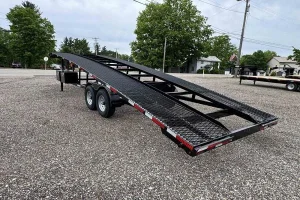
Table of Contents
Custom Your Trailers

Don’t hesitate to get in touch with us to explore our trailer and discuss how we can meet your unique requirements.

Find Your Trailer

Whether you've purchased a trailer before or are learning about trailers for the first time, we can help you find the right trailer for you.

Recently Posts

Leave a Comment

Your email address will not be published. Required fields are marked *

Scroll to Top
Three Horses Trailer

Find Your Trailer

Whether you've purchased a trailer before or are learning about trailers for the first time, we can help you find the right trailer for you.