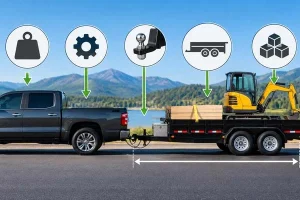
A utility trailer frame is the base structure that decides how strong, stable, and useful a trailer will be in real work. Buyers often compare trailer size, deck material, tires, or ramps first, but the frame is what carries the load, handles road vibration, supports the axle, and keeps the trailer straight during towing. If the frame is weak, even a good-looking trailer can fail under regular hauling.
For farms, landscaping companies, contractors, rental fleets, homeowners, and small transport businesses, the utility trailer frame must deal with different types of cargo. It may carry lawn equipment, motorcycles, building materials, garden tools, small machines, furniture, firewood, or general cargo. A well-built frame gives the trailer the strength it needs for repeated loading, road use, and outdoor storage.
Choosing the right utility trailer frame is not only about steel thickness. Buyers should also check frame layout, crossmember spacing, weld quality, tongue design, axle position, surface treatment, and how the frame matches the trailer's real payload. A strong frame can improve safety, reduce long-term maintenance, and make the trailer more reliable for daily work.

The frame is the skeleton of a utility trailer. It supports the deck, side rails, axle, suspension, lights, coupler, fenders, ramps, and cargo. When the trailer is loaded, the frame spreads the weight across the structure. When the trailer is moving, the frame must also handle bumps, turns, braking force, and road vibration.
A low-quality frame may bend, twist, crack, or wear faster than expected. This can cause uneven tire wear, poor towing behavior, deck damage, loose hardware, or safety problems. A strong utility trailer frame helps keep the trailer stable and gives users more confidence when carrying loads over short or long distances.
For business users, frame quality affects more than safety. It affects uptime. A trailer that needs frequent repair can delay delivery, slow down jobs, and increase operating costs. For buyers who use trailers every week, choosing a better frame from the beginning is usually more cost-effective than repairing a weak trailer later.
Landscaping teams often use utility trailers to carry zero-turn mowers, push mowers, trimmers, blowers, fuel cans, toolboxes, and garden supplies. These loads may not always be extremely heavy, but they are used frequently. The frame needs enough strength to handle repeated loading and unloading without becoming loose or uneven.
On farms and ranches, a trailer may carry feed bags, fencing materials, water tanks, small tractors, tools, firewood, or animal care equipment. The trailer frame needs to handle rougher ground and outdoor use. A strong utility trailer frame with good surface protection can help the trailer last longer in dusty, wet, or muddy conditions.
Contractors may use utility trailers for lumber, ladders, cement bags, generators, compressors, scaffolding parts, and jobsite tools. These loads can be heavy and uneven. The frame must be able to support concentrated weight and resist twisting when the trailer is loaded from one side or driven over uneven roads.
Homeowners often use utility trailers for moving furniture, garden waste, appliances, motorcycles, ATVs, camping gear, and household materials. Even for personal use, frame strength still matters. A well-made frame gives the trailer better stability and helps prevent problems during weekend hauling or long trips.
Rental trailers are used by many different people, and not every user handles equipment carefully. For rental fleets, the utility trailer frame should be strong, simple, and easy to inspect. Durable construction can reduce repair frequency and help the trailer stay in service longer.
The main rails run along the length of the trailer and carry much of the load. They are one of the most important parts of the utility trailer frame. Buyers should check the steel profile, thickness, straightness, and connection quality. Strong main rails help the trailer resist bending under cargo weight.
If the trailer will be used for heavier cargo or commercial work, the main rails should be matched to the expected payload. A light frame may be fine for garden tools, but it may not be suitable for compact machines, building materials, or frequent business hauling.
Crossmembers connect the left and right sides of the frame and support the deck. Their spacing affects deck strength and load distribution. If crossmembers are too far apart, the deck may flex under heavy or concentrated loads. Closer and stronger crossmembers can help improve the trailer's support.
Buyers should pay attention to crossmember layout if they plan to load small machines, pallets, motorcycles, or cargo with narrow contact points. A good frame design spreads load pressure more evenly and helps protect both the deck and the main frame.
The tongue connects the trailer to the towing vehicle, so its design is critical for towing safety. A-frame tongues are common because they provide good support and stability. The tongue should be strong enough for the trailer's rated capacity and should connect cleanly to the main frame.
A weak tongue can create towing problems, especially when the trailer is heavily loaded or driven over rough roads. Buyers should check welds, steel size, coupler rating, safety chain attachment, and jack mounting position.
The axle mounting area must be strong because it carries both load weight and road impact. Poor axle mounting can affect alignment, tire wear, and trailer balance. A well-built utility trailer frame should have reinforced mounting points that match the axle rating and suspension design.
Buyers should also consider axle position. Good axle placement helps balance tongue weight and towing stability. If the axle is placed poorly, the trailer may sway, overload the hitch, or become difficult to control.
Many utility trailers use side rails to help contain cargo and provide tie-down support. These rails depend on the frame for strength. If the side rail posts are weak or poorly connected, they may bend when cargo shifts or when straps are tightened.
Buyers who carry equipment, boxes, tools, or loose cargo should check the side rail connection points. Strong rail supports help make the trailer safer and more practical for daily hauling.
Steel material and thickness have a direct effect on frame strength. Thicker steel can provide better load support, but good design is just as important. A heavy frame with poor layout may not perform as well as a properly engineered frame with suitable steel profiles.
Buyers should ask what type of steel is used, how the frame is designed, and what payload the frame is built to handle. For business use, the frame should be selected based on real cargo weight rather than appearance alone.
Welding quality is one of the easiest ways to judge a utility trailer frame. Clean and consistent welds usually show better manufacturing control. Poor welds may crack over time, especially near stress points such as the tongue, axle area, crossmembers, and ramp hinges.
Buyers should inspect welds for gaps, uneven beads, burn-through, or weak connection points. For fleet buyers and dealers, stable welding quality is important because every trailer should meet the same standard.
Frame layout decides how weight is carried and how the trailer behaves on the road. Main rails, crossmembers, tongue supports, corner reinforcements, and axle mounts should work together. A strong layout helps reduce flex and keeps the trailer steady during towing.
Buyers should think about their cargo type. A trailer for light garden waste may not need the same structure as a trailer for construction tools or compact machines. The best frame layout should match the trailer's real use.
Utility trailers are often stored outdoors and used in rain, mud, dust, and road salt. Surface treatment helps protect the frame from corrosion. Painted finishes, powder coating, and galvanized treatment are common options, but they do not perform the same in every environment.
For buyers in coastal areas, wet regions, farms, or heavy outdoor work, corrosion resistance should be taken seriously. A stronger surface treatment can extend frame life and reduce long-term maintenance.
The utility trailer frame should match the trailer's rated payload. Buyers should not only think about the cargo they carry today. They should also consider future jobs. Many people buy a trailer for light work and later use it for heavier cargo, which can overload the frame.
A safe payload rating should include cargo weight, added accessories, toolboxes, ramps, spare tires, and any mounted equipment. Leaving a safety margin helps reduce stress on the frame and improves towing stability.
A practical frame should support tie-down points, side rails, ramp gates, toolboxes, spare tire mounts, lights, and other accessories. These parts must be connected to strong areas of the frame, not just thin deck material. Good mounting design helps keep cargo secure.
Buyers should think about how they will use the trailer every day. If the frame does not support the right accessories, the trailer may become less useful even if the base structure is strong.
Most utility trailer frames are made from steel because steel provides a good balance of strength, cost, repairability, and durability. Steel frames are suitable for farms, contractors, landscaping companies, rental fleets, and general hauling. The key is choosing the right steel profile and frame design for the expected load.
Painted steel frames are common and cost-effective. Powder-coated frames can offer a cleaner finish and better surface durability than basic paint when applied properly. Galvanized frames are often chosen for better corrosion resistance, especially in wet, coastal, or outdoor working environments.
Buyers should choose surface treatment based on where and how the trailer will be used. A trailer stored in a dry garage may not need the same protection as a trailer used on farms, near saltwater, or in rainy regions. The frame finish should match the real working environment, not just the initial purchase price.
A utility trailer frame can be customized for different trailer types and work needs. Some buyers need a light open frame for simple cargo. Others need a stronger frame for equipment, side rails, ramp gates, or heavier loads. Customization helps the trailer match the buyer's use instead of forcing the buyer to adapt to a standard design.
- Different frame lengths and widths
- Single axle or tandem axle layout
- A-frame tongue or custom drawbar design
- Extra crossmembers for stronger deck support
- Reinforced axle mounting areas
- Side rail and ramp gate support
- Toolbox and spare tire mounting points
- Custom tie-down point positions
- Painted, powder-coated, or galvanized finish
- Frame design for wood deck, steel deck, or mesh deck
For dealers and B2B buyers, customization can also help match local market demand. Some markets prefer light utility trailers for homeowners, while others need stronger models for farms and contractors. A flexible frame design makes it easier to build trailers for different buyer groups.
The right utility trailer frame depends on what the trailer will carry. For lawn care and light home use, buyers may focus on simple structure, easy towing, and practical side rails. For construction and farm use, stronger main rails, closer crossmembers, and better corrosion protection may be more important.
Buyers should also think about how the trailer will be loaded. Cargo loaded by hand creates different stress from cargo loaded by a forklift, ramp, or small machine. If heavy equipment will be driven onto the trailer, the rear frame, ramp support, deck, and crossmembers should be strong enough for concentrated wheel loads.
Road conditions matter too. A trailer used only on smooth city roads may not need the same reinforcement as a trailer used on farms, jobsites, gravel roads, or long-distance routes. A utility trailer frame should be designed for both the cargo and the road environment.
A better utility trailer frame is usually easy to recognize when you know what to check. The frame should look straight, balanced, and well-supported. Welds should be clean. Crossmembers should be placed where the deck needs support. The tongue should connect firmly to the main frame. Axle mounting areas should be reinforced and aligned.
Good frames are also practical. They provide proper places for tie-down points, lights, fenders, ramps, safety chains, and accessories. A strong frame that is difficult to use every day is not ideal. A useful trailer frame should combine strength, safety, and convenience.
- Straight frame with clean alignment
- Strong main rails and crossmembers
- Well-supported tongue structure
- Reinforced axle mounting points
- Consistent weld quality
- Good corrosion protection
- Practical tie-down and accessory support
- Frame layout matched to the trailer's payload
Regular maintenance helps keep a utility trailer frame safe and reliable. Buyers should inspect the frame after heavy use, long trips, or rough road conditions. Look for cracks, rust, loose bolts, bent areas, damaged welds, and unusual movement around the tongue or axle area.
Cleaning is also important. Mud, fertilizer, salt, and road chemicals can stay on the frame and speed up corrosion. After using the trailer in wet or dirty conditions, washing the frame can help protect the surface finish and reduce rust risk.
For business users, a simple inspection schedule can prevent bigger problems. Checking the frame, tires, lights, coupler, safety chains, brakes, and tie-down points before use helps reduce downtime and improves road safety.
A utility trailer frame is the main support structure of a utility trailer. It carries the deck, axle, tongue, side rails, fenders, lights, and cargo. The frame affects the trailer's strength, towing stability, payload, and service life.
The frame decides how well the trailer handles weight and road stress. A weak frame may bend, crack, or cause poor towing performance. A strong frame helps the trailer carry cargo safely and last longer.
Steel is commonly used because it provides strength, durability, and good repairability. Buyers can choose different steel profiles, thicknesses, and surface treatments based on load requirements and working conditions.
Check the frame material, main rail size, crossmember spacing, weld quality, axle mounting area, tongue design, and payload rating. The frame should match the cargo weight and the way the trailer will be used.
Galvanized treatment can provide better corrosion resistance than basic paint in wet, coastal, or outdoor environments. It may be a good choice for buyers who use or store trailers in harsh weather conditions.
Yes. Common custom options include frame size, axle layout, crossmember spacing, tongue style, tie-down positions, ramp support, side rail support, and surface treatment. Customization helps match the trailer to real hauling needs.
Common causes include overloading, poor weight distribution, rough road use, weak welds, corrosion, impact damage, and lack of maintenance. Using the trailer within its rated capacity and checking it regularly can reduce frame damage.
For personal use, inspect the frame before long trips or after heavy loads. For business or rental use, check it more often. Pay special attention to the tongue, axle mounts, welds, crossmembers, and areas where rust may appear.
Yes. Crossmember spacing affects deck support and load distribution. Closer or stronger crossmembers can help support heavier loads, small machines, or cargo with concentrated contact points.
Commercial users usually need a stronger frame with durable main rails, good crossmember support, reinforced axle mounts, practical tie-down points, and reliable surface treatment. The best design depends on cargo type, road conditions, and daily use frequency.
A utility trailer frame is one of the most important parts of a trailer. It affects strength, payload, towing stability, service life, and daily usability. Whether the trailer is used for landscaping, farming, construction, home hauling, or rental service, a strong frame helps the trailer work safely and reliably.
Buyers should check more than the trailer's size or appearance. Main rails, crossmembers, tongue design, axle mounting, weld quality, surface treatment, tie-down support, and payload rating all matter. A well-built utility trailer frame gives the trailer a stronger foundation and better value over years of use.