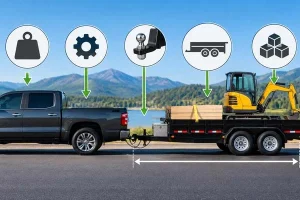
A standard car trailer usually weighs between 1,300 and 3,500 pounds when empty. However, that range only gives you a starting point. A lightweight aluminum open car hauler may weigh close to 1,300 pounds, while a steel enclosed car trailer of a similar length may weigh 3,500 pounds or more before a vehicle is loaded. If you are asking how heavy a car trailer is because you plan to buy one, tow one, or match one to your truck, the empty weight alone is not enough. You also need to calculate the weight of the car, the winch, spare tires, tie-down straps, tools, batteries, ramps, fuel, and any other equipment carried on the trailer.
The most useful answer is this: a loaded single-car trailer often weighs between 5,000 and 8,000 pounds. Some lightweight combinations remain below 5,000 pounds, while enclosed racing trailers, equipment-style car haulers, and heavy vehicles can push the total well above 8,000 pounds. That final loaded figure affects the tow vehicle, receiver hitch, trailer brakes, tires, suspension, payload capacity, and stopping distance. It also determines whether your towing setup remains within the limits printed by the truck and trailer manufacturers. A trailer can look small behind a pickup, but once it carries a 4,000-pound car, it becomes a serious load that needs careful planning.

For most buyers, the key point is simple: do not choose a car trailer by deck length alone. Check the empty trailer weight, gross vehicle weight rating, payload capacity, axle ratings, tire ratings, and the actual weight of the vehicle you intend to transport.
Most open car trailers weigh between 1,500 and 3,000 pounds when empty. Most enclosed car trailers weigh between 2,500 and 4,500 pounds, although longer or heavily equipped models may weigh much more. This difference matters because the trailer uses part of its own rated capacity before you load the car. For example, a trailer with a 7,000-pound gross vehicle weight rating and an empty weight of 2,000 pounds has about 5,000 pounds available for the vehicle and additional cargo. If the same 7,000-pound trailer weighs 3,500 pounds because it has an enclosed body, cabinets, a steel floor, and heavy doors, only about 3,500 pounds remains for the car and equipment.
Think of the trailer rating like the weight limit on an elevator. The limit applies to the elevator and everything inside it, not only the passengers. In the same way, the trailer's gross vehicle weight rating includes the trailer itself, the transported car, the loading equipment, and every loose item carried during the trip. This is why a large-looking trailer does not always have a large payload capacity. A longer enclosed model may provide more usable space, yet its heavier structure can leave less capacity for the vehicle.
| Car Trailer Type | Typical Empty Weight | Common Loaded Weight | Typical Use |
|---|---|---|---|
| Lightweight aluminum open trailer | 1,300 to 1,800 lb | 4,500 to 6,500 lb | Sports cars, compact cars, and regular road vehicles |
| Steel open car hauler | 1,900 to 3,000 lb | 5,500 to 8,000 lb | Sedans, SUVs, pickups, tractors, and general hauling |
| Enclosed car trailer | 2,500 to 4,500 lb | 6,000 to 10,000 lb | Classic cars, race cars, show cars, and weather-protected transport |
| Heavy-duty equipment-style car trailer | 3,000 to 5,000 lb | 8,000 to 14,000 lb | Heavy pickups, machinery, skid steers, and commercial transport |
| Gooseneck multi-car trailer | 5,000 to 8,000 lb or more | 12,000 to 25,000 lb or more | Multiple vehicles, commercial hauling, and heavy equipment |
Empty weight describes what the trailer weighs before the vehicle and loose cargo are added. Depending on the manufacturer, this number may also be called curb weight, dry weight, base weight, or shipping weight. These terms are often used in a similar way, but they may not include the same equipment. One manufacturer may include standard ramps and a spare tire in the published weight, while another may list the weight of the basic trailer before optional ramps, a winch, a toolbox, or a battery are installed. When comparing car trailers by weight, always check what the published figure includes.
Loaded weight is the real operating weight of the trailer during transport. It includes the empty trailer, the car, extra wheels, loading equipment, tools, spare parts, tie-down equipment, and every other item carried on the trailer. This is the number the tow vehicle must accelerate, control, and stop. It is also the number that must remain below the trailer's gross vehicle weight rating. A trailer that weighs 2,100 pounds empty may sound manageable, but if it carries a 4,200-pound vehicle and 300 pounds of equipment, the loaded trailer weight becomes 6,600 pounds.
Why should you focus on the loaded figure? Because towing problems rarely happen while the trailer is sitting empty in the yard. Braking distance, transmission heat, trailer sway, tire stress, and hitch load all increase after the car is placed on the deck. The empty weight is useful when comparing products, but the loaded weight tells you whether the complete setup is suitable for the road.
The calculation is straightforward when you have accurate numbers. Add the empty trailer weight to the actual vehicle weight, then add the weight of all equipment and cargo. Avoid relying only on the vehicle's advertised curb weight because the car may contain fuel, accessories, personal items, aftermarket parts, or modifications that increase its actual weight. A race car with a roll cage, upgraded brakes, spare wheels, and track equipment may weigh more than expected even if the base vehicle was originally lightweight.
Suppose your steel open car trailer weighs 2,100 pounds. The car weighs 3,700 pounds, and the winch, battery, straps, spare tire, toolbox, and wheel chocks add another 250 pounds. The total loaded weight is 6,050 pounds. If the trailer has a 7,000-pound gross vehicle weight rating, the combination is under the maximum rating, but the remaining margin is only 950 pounds. You still need to check axle capacity, tire capacity, tongue weight, hitch rating, tow vehicle payload, and towing capacity before deciding that the setup is suitable.
GVWR means gross vehicle weight rating. It is the maximum loaded weight that the trailer manufacturer assigns to the complete trailer. The rating includes the trailer and everything carried on it. A 7,000-pound GVWR car trailer does not normally weigh 7,000 pounds when empty. It means the trailer should not weigh more than 7,000 pounds after the car and all equipment have been loaded.
This distinction is important when shopping for a trailer because product listings often place the GVWR in a prominent position. A buyer may see "7,000 lb car trailer" and assume the trailer can carry a 7,000-pound vehicle. In reality, the trailer's empty structure may use 2,000 to 3,500 pounds of that rating. The true payload capacity could therefore be between 3,500 and 5,000 pounds. That may be enough for a compact car or midsize sedan, but it may not be enough for a large SUV, electric vehicle, heavy pickup, or armored vehicle.
Payload capacity tells you how much vehicle and cargo the trailer can carry. The basic calculation is the trailer's gross vehicle weight rating minus its empty weight. For example, if a trailer has a 10,000-pound GVWR and weighs 2,800 pounds empty, its theoretical payload capacity is 7,200 pounds. However, this does not mean you can ignore axle, tire, coupler, or deck limits. The safe capacity of the complete trailer is controlled by its rated components and the manufacturer's specification.
The word "theoretical" matters because optional equipment changes the real number. If you add a 100-pound winch, a 70-pound battery and box, a 100-pound spare wheel assembly, and 150 pounds of tools, you have already used 420 pounds of the published payload. The car itself is not the only cargo. For this reason, commercial haulers and racing teams often weigh the finished trailer rather than trusting the original brochure figure.
An open car trailer usually weighs between 1,300 and 3,000 pounds when empty. It is generally lighter than an enclosed trailer because it does not have full-height side walls, a roof, a rear enclosure door, interior wall panels, roof supports, cabinets, or ventilation equipment. Open trailers are popular for transporting road cars, project vehicles, tractors, UTVs, and light machinery because they provide a useful balance between deck space, payload capacity, and purchase cost.
A lightweight aluminum open trailer may weigh between 1,300 and 1,800 pounds. A standard steel open car hauler with two 3,500-pound axles often weighs between 1,900 and 2,500 pounds. Heavy steel models with a full steel deck, thick frame rails, larger axles, drive-over fenders, hydraulic tilt equipment, or long loading ramps may weigh close to 3,000 pounds or more. The weight can therefore vary widely even when two trailers have the same deck length.
Open trailers make sense when the buyer wants to keep the total towing weight lower and does not need full protection from weather or road debris. They are also easier to inspect during loading because the wheels, straps, and vehicle position remain visible. The disadvantage is that the transported car stays exposed to rain, dust, stone chips, road salt, and unwanted attention. The right choice depends on whether lower empty weight or greater protection matters more for your use.
A typical enclosed car trailer weighs between 2,500 and 4,500 pounds when empty, but longer racing trailers and heavily equipped workshops can weigh considerably more. The enclosure adds structural posts, wall sheets, roof bows, exterior skin, interior panels, doors, flooring, lights, wiring, ventilation, and hardware. Even before cabinets or racing equipment are installed, these parts can add more than 1,000 pounds compared with a lightweight open car hauler.
The main benefit is protection. An enclosed trailer shields a classic car, race car, luxury vehicle, or restoration project from rain, sun, road debris, and public view. It can also provide space for tools, spare wheels, workbenches, cabinets, and team equipment. However, every added feature reduces the remaining payload capacity. A 7,000-pound GVWR enclosed trailer that weighs 3,500 pounds empty has only about 3,500 pounds left for the vehicle and equipment. That may be too little for many modern sedans, crossovers, and electric vehicles.
An enclosed trailer also creates more aerodynamic drag than an open model. Weight and wind resistance are different issues, but both affect towing performance. A large box-shaped trailer can increase fuel consumption and make the tow vehicle work harder at highway speed, especially in headwinds or on steep grades. Buyers should therefore consider the trailer's height and frontal area as well as its published weight.
An aluminum car trailer commonly weighs between 1,300 and 2,200 pounds when empty, depending on its length, frame design, axle package, deck style, and loading system. Aluminum is attractive because it can reduce the trailer's empty weight while preserving more capacity for the transported vehicle. If two trailers share a similar gross vehicle weight rating, the lighter trailer normally provides more usable payload.
For example, imagine an aluminum trailer and a steel trailer that are both rated at 7,000 pounds. If the aluminum trailer weighs 1,500 pounds, it may offer about 5,500 pounds of payload. If the steel trailer weighs 2,300 pounds, it may offer about 4,700 pounds. The aluminum model gives the buyer an additional 800 pounds for the car, winch, tools, and other equipment. That difference can determine whether a trailer is suitable for a heavier sedan or SUV.
Aluminum does not mean that every part of the trailer is lightweight. Axles, couplers, hubs, brakes, suspension parts, fasteners, jacks, and reinforcement plates may still be made from steel. A heavy-duty aluminum equipment trailer can also weigh more than a basic steel car hauler. Compare complete specifications rather than assuming material alone tells the full story.
A steel open car trailer usually weighs between 1,900 and 3,200 pounds when empty. Steel enclosed trailers often weigh between 3,000 and 5,000 pounds or more. Steel is widely used because it is strong, familiar to repair shops, and suitable for many frame designs. It can also offer a lower purchase price than a comparable aluminum model. The trade-off is greater empty weight and a need for proper corrosion protection.
The frame design has a major influence on the final number. A simple open trailer with channel rails and a wood deck may remain close to 2,000 pounds. A trailer with a full steel floor, deep frame rails, closely spaced crossmembers, heavy fenders, large ramps, 5,200-pound axles, and a reinforced tongue may exceed 3,000 pounds. If the same trailer includes an enclosed body, cabinets, a generator, and racing equipment, the weight can climb much higher.
Steel can still be the right choice for buyers who need a robust trailer and have a properly rated tow vehicle. The important step is to calculate how much payload remains after the trailer's own weight is deducted. A strong trailer is only useful when it has enough remaining capacity for the vehicle you need to move.
An 18-foot car trailer usually weighs between 1,400 and 2,800 pounds when empty. Lightweight aluminum models tend to sit near the bottom of this range, while steel trailers with full decks, heavy ramps, tilt systems, or larger axles sit near the top. An enclosed 18-foot trailer can weigh 2,500 to 4,000 pounds depending on its construction and equipment.
Why is 18 feet such a common length? It gives many buyers enough room for a standard passenger car while remaining easier to store and tow than a much longer trailer. However, the deck must fit more than the total vehicle length. You also need enough space to position the car correctly over the axles and create proper tongue weight. A trailer that barely fits the car may leave little room to adjust the load forward or backward.
Before purchasing an 18-foot car trailer, check the wheelbase, total vehicle length, ground clearance, track width, curb weight, and front overhang of the vehicle you plan to carry. A trailer that works well for a compact sports car may not be suitable for a long pickup, low supercar, or heavy electric sedan. Weight and dimensions must be checked together.
A 20-foot open car trailer commonly weighs between 1,500 and 3,200 pounds when empty. A 20-foot enclosed car trailer often weighs between 3,000 and 4,500 pounds before cabinets, spare tires, tools, and racing equipment are added. The additional deck length provides more room for longer vehicles and gives the driver more flexibility when positioning the car for correct tongue weight.
The extra length also adds frame material, crossmembers, decking, wiring, and sometimes stronger structural components. That means a 20-foot trailer usually weighs more than a similar 16-foot or 18-foot model. The difference may only be a few hundred pounds within the same product series, but those pounds still reduce the remaining payload capacity. If the gross vehicle weight rating stays the same, the longer trailer may carry less cargo than the shorter version.
A 20-foot deck is often a practical choice for pickups, long sedans, classic cars, and vehicles that need careful positioning. It can also provide room for a front-mounted toolbox or winch. However, buyers should not purchase extra length without checking storage space, turning clearance, total combination length, and the tow vehicle's ability to control the heavier trailer.
Car trailer weight does not come from one component. It builds gradually through the frame, deck, axles, suspension, brakes, ramps, tires, coupler, jack, wiring, and optional equipment. A few extra feet of deck may add a modest amount of weight, while a full steel floor, hydraulic tilt system, heavy-duty axle package, or enclosed body can add hundreds of pounds. The final trailer may therefore weigh much more than a simple visual estimate suggests.
A buyer should pay particular attention to features that sound small when listed separately. A winch may require a mounting plate, battery, battery box, wiring, and front guard. A spare tire requires a wheel, tire, bracket, and mounting hardware. Long loading ramps need storage supports or slide-in channels. A toolbox may later be filled with chains, straps, jacks, and repair equipment. Once all these items are combined, they can remove several hundred pounds from the available payload.
Longer trailers need more frame rail, more crossmembers, more flooring, and longer wiring. A two-foot increase may seem minor, but it can also require additional reinforcement or a different axle position. The added length is useful when transporting long vehicles or adjusting load placement, yet it should be selected for a clear reason. More deck space is not free because it adds weight, cost, and storage requirements.
Wood, aluminum plank, expanded metal, open runners, and steel plate all create different weight profiles. Open runners can keep the trailer lighter because material is only placed under the vehicle's tires. A full deck provides more flexibility for carrying other cargo, but it adds material across the entire trailer. Full steel floors are often among the heaviest options, while aluminum decking can reduce weight at a higher purchase cost.
Higher-capacity axles usually come with heavier tubes, hubs, brakes, bearings, wheels, tires, springs, and suspension hardware. A trailer with two 3,500-pound axles will often weigh less than one with two 7,000-pound axles. The heavier setup may carry larger vehicles and machinery, but it also requires a stronger frame and coupler. Buyers should choose axle capacity based on the intended load rather than assuming the largest available package is always necessary.
Steel loading ramps can be heavy, especially when they are long enough to reduce the loading angle for low-clearance vehicles. Hydraulic or powered tilt systems add hinges, cylinders, pumps, fluid, controls, a battery, and reinforcement. These systems make loading easier, but their weight becomes part of the empty trailer weight. When comparing a tilt trailer with a ramp trailer, include the complete loading system in the calculation.
Accessories often create the difference between the brochure weight and the weight of the trailer that actually travels on the road. A winch setup, spare wheel, storage box, electric jack, wheel chocks, straps, chains, battery, solar charger, fuel cans, and repair tools can add 200 to 500 pounds. Enclosed racing trailers may carry cabinets, workbenches, generators, air conditioners, tire racks, awnings, and interior wall panels. These features may be useful, but they must be treated as cargo when calculating the loaded weight.
A car trailer with a vehicle loaded on it commonly weighs between 5,000 and 8,000 pounds. A lightweight setup may consist of a 1,400-pound aluminum trailer and a 3,000-pound sports car, producing a total near 4,400 pounds before accessories. A heavier combination may include a 3,500-pound enclosed trailer, a 4,200-pound sedan, and 500 pounds of tools and equipment, bringing the total to 8,200 pounds.
Modern vehicle weight deserves close attention. Many buyers still picture a normal passenger car as weighing around 3,000 pounds, but larger sedans, crossovers, luxury vehicles, and electric vehicles can weigh 4,000 to 6,000 pounds or more. Battery packs make some electric vehicles much heavier than similarly sized gasoline models. A trailer that works comfortably for a lightweight race car may be overloaded by a heavy electric SUV.
Do not estimate the transported vehicle by appearance. Check its door label, registration documents, manufacturer specifications, or actual scale weight. Then include the fuel level and modifications. A lifted truck with larger wheels, steel bumpers, a winch, tools, and cargo can weigh far more than the original factory figure.
Tongue weight is the downward force that the trailer applies to the hitch ball. For many conventional bumper-pull trailers, the target is often around 10% to 15% of the loaded trailer weight, although the trailer and tow vehicle manufacturers should provide the final guidance. A loaded trailer weighing 6,000 pounds may therefore place roughly 600 to 900 pounds on the hitch.
That weight does not disappear because the truck has a high towing rating. Tongue weight becomes part of the tow vehicle's payload. Passengers, luggage, tools, bed cargo, aftermarket accessories, and the hitch itself also use the same payload allowance. A pickup may have enough engine power to tow 8,000 pounds but still exceed its payload capacity after a heavy trailer tongue and several passengers are added.
Load position affects tongue weight. Moving the car too far forward can overload the hitch and rear axle. Moving it too far backward can reduce tongue weight and increase trailer sway. The vehicle should be positioned so the trailer remains stable while all ratings stay within their limits. A tongue weight scale or certified vehicle scale provides more reliable information than judging the position by appearance.
Your truck can tow the trailer only when the complete setup remains within every relevant rating. Start with the towing capacity for the exact truck configuration, not the highest number used in advertising. Engine choice, axle ratio, transmission, cab style, bed length, drivetrain, cooling package, wheel package, and factory towing equipment can all change the rating. Two trucks with the same model name may have very different capabilities.
Next, check payload capacity. The payload label is usually found inside the driver's door area. Subtract the weight of passengers, bed cargo, accessories, the hitch, and estimated trailer tongue weight. If the result becomes negative, the truck is overloaded even when the trailer remains below the published towing limit. This is one of the most common mistakes made when choosing a tow vehicle for a car trailer.
You should also verify the receiver hitch, ball mount, hitch ball, coupler, safety chains, trailer tires, truck tires, trailer axles, and brake system. The lowest-rated component controls the safe limit. A heavy-duty receiver does not increase the truck manufacturer's towing capacity, and stronger trailer tires do not increase the trailer's certified gross vehicle weight rating.
- Check the exact tow vehicle towing capacity.
- Check the tow vehicle payload capacity.
- Calculate loaded trailer weight.
- Calculate or measure tongue weight.
- Verify receiver, ball mount, and hitch ball ratings.
- Confirm trailer GVWR, axle ratings, and tire ratings.
- Confirm that the trailer brakes operate correctly.
- Leave a reasonable safety margin for real-world travel.
Begin with the trailer identification plate, manufacturer specification sheet, original invoice, title documents, or certificate of origin. These records may show the gross vehicle weight rating, axle ratings, tire specifications, and empty weight. Use the full model number because trailers of the same length may have different frames, decks, axles, and options.
Published figures are less reliable when the trailer has been modified. A used trailer may have a replacement floor, repair plates, added crossmembers, a winch, a storage box, spare tire carriers, cabinets, a generator, or a larger jack. These changes increase the actual weight without changing the original paperwork. Rust repairs and reinforcement can also make an older steel trailer heavier than its factory specification.
The most accurate method is to use a certified vehicle scale. Weigh the trailer in the same condition in which it normally travels. Include the spare tire, ramps, straps, battery, toolbox, and permanently installed equipment. You can then weigh it again with the vehicle and cargo loaded. The scale ticket gives you a real operating number instead of an estimate based on a catalog.
Choose a trailer by starting with the heaviest vehicle you realistically expect to transport. Add the weight of the winch, straps, spare wheels, tools, fuel, batteries, and other equipment. Then select a trailer with enough payload capacity to carry the complete load without operating at its absolute maximum rating on every trip. A reasonable margin helps account for future accessories, measurement differences, and changes in the vehicle being hauled.
For example, suppose the car weighs 4,000 pounds and the equipment adds 400 pounds. A trailer with only 4,500 pounds of payload leaves almost no margin. A trailer with 5,500 or 6,000 pounds of payload provides more flexibility, assuming the tow vehicle can safely handle the resulting weight. The goal is not to buy the highest-rated trailer available. The goal is to create a balanced combination in which the trailer, hitch, and tow vehicle are properly matched.
Also consider how the trailer will be used. A lightweight aluminum trailer may be ideal for frequent transport with a half-ton pickup. A steel open trailer may suit general work and occasional vehicle hauling. An enclosed trailer may be better for a valuable race car that needs weather protection and secure storage. A heavy-duty gooseneck may be necessary for multiple vehicles or commercial equipment. The best trailer weight depends on the job, not only the product price.
The first common mistake is confusing GVWR with payload capacity. A 10,000-pound GVWR trailer cannot usually carry 10,000 pounds of cargo because the trailer itself may weigh 2,500 to 4,000 pounds. The second mistake is using the car's estimated weight instead of checking the actual model and configuration. The third mistake is forgetting equipment that stays on the trailer, including the winch, battery, spare wheels, ramps, straps, toolboxes, and fuel containers.
Another mistake is focusing only on the tow rating while ignoring payload and tongue weight. A truck can remain below its towing limit and still exceed its payload, rear axle, tire, or receiver rating. Buyers also sometimes assume that adding stronger tires or suspension parts increases the official towing capacity. Aftermarket parts may improve handling or durability, but they do not rewrite the ratings assigned by the vehicle manufacturer.
The final mistake is loading the car without checking weight distribution. A trailer with too little tongue weight may sway. A trailer with too much tongue weight may overload the tow vehicle and reduce steering control. Accurate loading requires more than keeping the total below the GVWR. The weight must also be distributed correctly across the hitch and axles.
A basic open car trailer normally weighs between 1,500 and 2,500 pounds when empty. Lightweight aluminum models may weigh closer to 1,300 pounds, while steel trailers with full decks, heavy ramps, or tilt systems may approach 3,000 pounds. The exact weight depends on the deck length, frame material, axle package, and standard equipment.
A car trailer carrying a normal sedan often weighs between 5,000 and 7,000 pounds. For example, a 2,000-pound trailer carrying a 3,500-pound sedan and 250 pounds of equipment would weigh about 5,750 pounds. A larger sedan or heavier trailer can push the combination above 7,000 pounds.
A car trailer carrying an SUV may weigh between 6,000 and 9,000 pounds or more. Many SUVs weigh between 4,000 and 6,000 pounds before cargo. Add a 2,000 to 3,000-pound trailer and the total can rise quickly. Confirm that the trailer payload is sufficient because many 7,000-pound GVWR car trailers cannot carry a heavy SUV.
No. A 7,000-pound GVWR trailer is rated for a maximum combined weight of 7,000 pounds, including the trailer itself. If the empty trailer weighs 2,200 pounds, the approximate payload capacity is 4,800 pounds. Accessories and equipment must also be deducted from that available capacity.
Aluminum car trailers are often easier to match with a tow vehicle because their lower empty weight reduces the total load. A lighter trailer may also preserve more payload capacity for the transported car. However, stability, brakes, tire condition, tongue weight, aerodynamics, and load distribution still affect towing. Material alone does not guarantee an easy towing experience.
Yes. A longer trailer normally uses more frame material, crossmembers, decking, wiring, and reinforcement. A 20-foot model will usually weigh more than a comparable 16-foot or 18-foot model. The longer deck may provide better load positioning, but it also reduces available payload when the GVWR remains unchanged.
The winch alone may weigh between 50 and 150 pounds, depending on its pulling capacity and construction. The complete installation can weigh more because it may include a mounting plate, battery, battery box, cables, controls, fairlead, and protective housing. A full winch system can add 100 to 250 pounds to the trailer.
Yes. The spare tire, wheel, bracket, and mounting hardware all count toward the trailer's empty or loaded weight. If the manufacturer did not include the spare tire in the published base weight, it reduces the remaining payload capacity after installation.
Many conventional bumper-pull trailers are loaded with tongue weight near 10% to 15% of the total loaded trailer weight. A 6,000-pound loaded trailer may therefore place around 600 to 900 pounds on the hitch. Always follow the trailer and tow vehicle manufacturer's instructions because the correct range can depend on the specific setup.
Some half-ton pickups can tow a loaded car trailer, but the answer depends on the exact truck configuration and the total trailer weight. Payload capacity is often the limiting factor because trailer tongue weight, passengers, cargo, and the hitch all load the truck. Check the truck's door label, owner's manual, towing guide, receiver rating, and gross combined weight rating before towing.
A midsize SUV may tow a lightweight car trailer and a small vehicle if the combination remains within all ratings. However, many loaded car trailers weigh more than 5,000 pounds and may exceed the SUV's towing capacity, payload, hitch rating, or braking capability. A short wheelbase and low payload can also make the combination less stable. Exact vehicle specifications must be checked before towing.
The best method is to use a certified vehicle scale with the trailer loaded exactly as it will travel. Include the car, tools, spare wheels, straps, fuel, passengers, and all equipment. A scale can show the total combination weight and axle-group weights. A separate tongue weight scale or a second weighing method can help determine how much load the trailer places on the tow vehicle.
So, how heavy is a car trailer? Most open car trailers weigh between 1,300 and 3,000 pounds when empty, while enclosed car trailers commonly weigh between 2,500 and 4,500 pounds. Heavy-duty equipment trailers and gooseneck car haulers can weigh much more. Once a vehicle and equipment are loaded, a typical single-car trailer combination often weighs between 5,000 and 8,000 pounds.
The empty trailer weight is only the beginning of the calculation. You need to add the actual vehicle weight, winch, battery, straps, ramps, tools, spare tires, fuel, and other cargo. Then compare the result with the trailer GVWR, payload capacity, axle ratings, tire ratings, hitch limits, tow vehicle towing capacity, and tow vehicle payload capacity. No single rating can confirm that the entire combination is suitable.
When the numbers are uncertain, weigh the completed setup on a certified scale. That measurement gives you a clear view of the real trailer weight and axle loading. Choosing the right car trailer is not about buying the biggest or strongest model available. It is about matching the trailer, transported vehicle, equipment, hitch, and tow vehicle so that every part of the combination works within its intended limits.