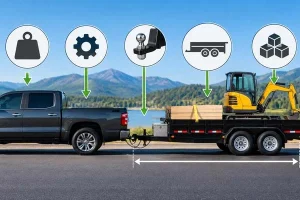
A gooseneck lowboy tilt trailer is built around one practical idea: make heavy equipment easier to load without forcing operators to handle separate loading ramps every time a machine goes on or off the trailer. By combining a low deck, a tilting loading surface, and a gooseneck connection to the tow vehicle, this trailer configuration is particularly useful for contractors, equipment rental fleets, farms, landscapers, construction crews, and other businesses that move machinery regularly. But the tilt mechanism alone should not decide a purchase. Payload, loading angle, deck dimensions, axle capacity, hitch compatibility, tie-down locations, and the type of equipment being transported all need to be considered together.

A gooseneck lowboy tilt trailer combines three design characteristics that directly affect how it loads, tows, and carries equipment. The gooseneck places the coupling point in the bed of the tow vehicle rather than behind the rear bumper. The lowboy configuration keeps the equipment deck relatively low to the ground. The tilt deck then allows part or all of the loading surface to slope toward the ground so machinery can drive onto the trailer.
For a commercial buyer, those features solve different problems. A lower deck can reduce the transition angle between the ground and trailer. A tilting deck can reduce dependence on removable ramps. A gooseneck connection is commonly selected for larger equipment trailers where towing stability and weight distribution are important. The result is a trailer configuration well suited to repeated equipment loading rather than occasional light-duty hauling.
Deck height has a direct effect on loading geometry. When the trailer deck sits lower, the equipment generally has a shorter vertical distance to climb. That can produce a more manageable approach angle when the deck tilts toward the ground. This becomes especially important when transporting machines that do not have generous ground clearance.
The benefit is easy to overlook when comparing trailers only by GVWR or overall deck length. In day-to-day work, however, operators may load and unload several times during one shift. A trailer that matches the machine's clearance and wheelbase can make those repeated loading cycles considerably easier to manage.
The relationship between deck height and tilt length determines much of the loading angle. A longer tilting section can usually create a more gradual transition than a short deck reaching the same height. Buyers transporting compact equipment should therefore ask for the actual loading angle of the proposed configuration instead of assuming that every lowboy tilt trailer behaves the same way.
This matters for more than convenience. A steep transition can cause the underside of a low-clearance machine to contact the trailer at the breakover point. Before ordering, compare the trailer geometry with the wheelbase, ground clearance, tire size, and attachment position of the machines you expect to carry.
Ground clearance deserves particular attention when hauling scissor lifts, small rollers, compact loaders, low industrial machines, or other equipment with components close to the ground. Even when a machine's operating weight is comfortably within the trailer's payload capacity, it may still be poorly matched to the loading geometry.
If your fleet contains several machine types, do not design the trailer around the easiest machine to load. Check the equipment with the longest wheelbase, lowest clearance, and most difficult approach angle. That machine is often the one that determines the deck configuration you actually need.
A tilt deck changes the loading surface itself into the approach to the trailer. Depending on the design, the deck may tilt as one section or combine a stationary front section with a tilting rear section. The operator lowers or allows the deck to move toward the ground, drives or winches the equipment onto it, and then returns the deck to its transport position.
A stationary front deck can also be useful for attachments, buckets, tools, or cargo that does not need to move with the tilting section. When comparing layouts, think about the complete load rather than just the main machine. A skid steer may fit easily, for example, but an additional bucket or attachment can change the required usable deck length.
Gravity and hydraulic tilt systems achieve a similar loading objective but operate differently. A gravity tilt system relies largely on weight transfer and controlled deck movement. It can reduce the number of powered components involved. A hydraulic tilt system gives the operator powered control over deck movement and may be preferable when loading routines demand more deliberate positioning.
Neither option should be selected simply because it sounds more advanced. Consider loading frequency, equipment weight distribution, operator workflow, maintenance resources, battery requirements, and the conditions in which the trailer will work. For a fleet that loads equipment throughout the day, operating speed and consistency may justify additional hydraulic equipment. For another fleet, simpler operation may be the priority.
A properly specified gooseneck lowboy tilt trailer can serve a broad range of equipment-hauling jobs, but suitability always depends on the individual trailer's rated capacities and dimensions. Common loads can include compact tractors, skid steers, mini excavators, scissor lifts, small construction machines, landscaping equipment, utility vehicles, and other wheeled or tracked machinery.
The key phrase is properly specified. Two trailers that look almost identical can have different axle ratings, frame designs, deck lengths, tire ratings, and GVWR figures. A purchasing manager should therefore build the specification around known machine weights and dimensions rather than around a generic equipment category.
| Equipment Factor | Why It Matters | What to Check |
|---|---|---|
| Operating weight | Determines required payload capacity | Machine, attachment, fuel, and additional cargo weight |
| Overall length | Affects deck fit and load positioning | Usable deck length and axle position |
| Overall width | Determines whether equipment fits the deck | Deck width, tire width, and attachments |
| Ground clearance | Affects loading at the deck transition | Tilt angle and breakover clearance |
| Wheelbase or track length | Changes how the machine transitions onto the deck | Tilt section length and deck geometry |
| Tie-down locations | Affects securement planning | D-rings, stake pockets, rub rails, and machine anchor points |
Start with the heaviest realistic load, not the machine you move most often. Commercial trailers are frequently kept for years, and equipment fleets change. If the trailer is sized with almost no reserve capacity, buying a slightly heavier machine later can make the trailer unsuitable for the job.
Record the operating weight of the equipment, including attachments and normal operating fluids. Then account for buckets, forks, spare attachments, tools, or other cargo that may travel on the same trailer. The combined cargo weight needs to remain within the trailer's actual payload rating while also respecting axle, tire, wheel, hitch, and tow vehicle limits.
One of the most important distinctions for a trailer buyer is the difference between GVWR and payload. GVWR represents the maximum allowable loaded weight of the trailer. Payload is the amount of cargo the trailer can carry after the trailer's own weight is taken into account. In simple terms, a trailer's empty weight consumes part of its GVWR before a machine is loaded.
This is why comparing trailers only by a large GVWR number can be misleading. Ask the manufacturer for the finished trailer weight of the configuration being quoted and confirm the resulting payload. Added toolboxes, hydraulic systems, winches, heavier flooring, spare tires, and other options can increase empty trailer weight.
Usable deck space should be selected according to load position, not simply whether the machine physically fits between the front and rear edges. The equipment needs enough room to be positioned so that loaded weight is distributed appropriately. That may require more deck length than the machine's overall dimensions initially suggest.
Buyers should also distinguish between total deck length, stationary deck length, and tilt deck length. If part of the deck remains stationary, confirm that the tilting section is long enough for the intended machine. For businesses carrying several types of equipment, create a simple list of machine length, width, wheelbase, weight, and attachments before requesting a trailer quotation.
A gooseneck connection changes both the tow vehicle requirements and the way the trailer is coupled. Because the connection is located in the truck bed, buyers need a compatible tow vehicle and properly rated hitch installation. This should be considered early in the purchasing process, especially when a company operates several trucks that may need to tow the same trailer.
The trailer rating alone never determines whether a combination is suitable. Tow vehicle ratings, hitch rating, loaded trailer weight, axle limits, tire limits, and applicable road regulations all matter. Fleet buyers should check the complete truck-trailer combination rather than purchasing the trailer first and solving compatibility problems afterward.
Structural specifications deserve close attention on a trailer that will repeatedly carry concentrated equipment loads. Ask how the main frame and crossmembers are configured, where loads are supported, and what axle packages are available. The goal is not simply to find the heaviest-looking frame. The frame, axles, suspension, wheels, tires, coupler, and brakes need to work as one rated system.
Equipment type also changes how a trailer is loaded. A compact machine may place substantial weight over a relatively small footprint, while a longer vehicle distributes weight differently. Buyers should give the manufacturer actual machine information so the trailer configuration can be evaluated against real operating conditions.
Loading is only half of the equipment transport process. Once the tilt deck returns to its travel position, the machine must be secured using suitable anchor points and securement equipment for the load and applicable regulations. A commercial trailer should provide tie-down locations that are accessible after the machine has been positioned.
Think about securement before finalizing deck layout. If a machine blocks the most convenient anchor points when parked in the correct weight position, operators may be forced into awkward tie-down arrangements. D-rings, stake pockets, rub rails, chain storage, and winch provisions should be considered as working equipment rather than cosmetic options.
The main operational difference is how the equipment reaches the deck. A conventional equipment trailer may rely on detachable, slide-in, or fold-down ramps. A tilt trailer uses the deck itself as part of the loading path. For crews loading several times per day, eliminating repeated ramp handling can simplify the routine.
| Buying Consideration | Gooseneck Lowboy Tilt Trailer | Conventional Ramp Trailer |
|---|---|---|
| Loading method | Deck tilts toward the ground | Equipment travels over separate or attached ramps |
| Ramp handling | Usually reduced or eliminated for the main deck | May require positioning or storing ramps |
| System complexity | Tilt components require inspection and maintenance | Loading system can be mechanically simpler |
| Low-clearance equipment | Can be useful when the loading geometry is properly matched | Depends strongly on ramp length and angle |
| Best buying basis | Frequent equipment loading and suitable machine geometry | Loads that work well with the selected ramp configuration |
A tilt deck is therefore not automatically the better answer for every fleet. If equipment is rarely loaded, or if a specific machine works particularly well with long ramps, a conventional configuration may remain practical. The correct comparison should be based on loading frequency, equipment clearance, maintenance expectations, and operator workflow.
Useful options are the ones that solve a repeated operating problem. A winch, for example, can be valuable when non-running equipment must be recovered onto the trailer. Additional tie-down points can help a fleet carrying machines of different lengths. Toolboxes can keep chains and operating equipment organized, while hydraulic jacks can reduce manual work during frequent coupling and uncoupling.
- Winch and correctly rated winch mounting provision
- Additional D-rings or other suitable tie-down points
- Lockable chain and tool storage
- Spare tire and accessible spare tire mount
- Hydraulic jack options for frequent fleet use
- Appropriate deck surface for the machines being transported
- Work lights for early-morning or evening loading
- Battery charging provisions where powered accessories are fitted
Avoid selecting options simply because they appear on a long specification sheet. Every addition affects purchase price, trailer weight, maintenance, or all three. For a B2B fleet, an option earns its place when it saves operating time, improves load handling, or supports a recurring job requirement.
A short pre-trip inspection can catch problems before the loaded trailer reaches the road. Operators should check tires, wheels, brakes, lights, wiring, safety chains, coupling components, breakaway equipment, deck condition, tie-down points, and the tilt mechanism. Hydraulic systems should be checked for visible leaks, damaged hoses, and proper operation where fitted.
The inspection should also include the load itself. Confirm that the machine is positioned as planned and that securement equipment is correctly installed and in serviceable condition. Fleet managers can improve consistency by turning these checks into a written procedure rather than relying on individual operator habits.
Purchase price is only one part of trailer cost. A working trailer may spend years exposed to road debris, water, dust, jobsite mud, repeated loading cycles, and changing cargo. Tires, brakes, bearings, electrical connections, deck materials, hydraulic components, hinges, and securement points therefore deserve attention throughout the trailer's service life.
For fleet operators, downtime can cost more than an individual repair. When a trailer is required to move a skid steer or compact excavator to the next project, a failed component can delay both the machine and the crew waiting for it. Parts availability, service access, component standardization, and maintenance requirements are consequently useful purchasing criteria alongside the initial quotation.
A useful quotation starts with useful operating information. Instead of asking only for a price on a gooseneck lowboy tilt trailer, provide the supplier with the machines you intend to haul, their working weights, dimensions, attachments, loading frequency, tow vehicle information, and any unusual operating conditions.
- What is the finished trailer weight and actual payload of this configuration?
- What are the GVWR, axle, tire, wheel, coupler, and jack ratings?
- How long is the usable tilt section?
- What is the loading angle when the deck is fully tilted?
- Is the tilt system gravity-operated or hydraulically powered?
- Where are the standard tie-down points located?
- Can the deck layout accommodate the wheelbase and clearance of our equipment?
- What brake configuration is supplied?
- Which components require scheduled maintenance?
- Which options change the trailer's empty weight or payload?
These questions help turn a general product inquiry into a usable commercial specification. They also make quotations easier to compare because suppliers are responding to the same operating requirements rather than proposing trailers with very different capacities and equipment packages.
It can be a practical configuration for transporting skid steers when the trailer is correctly rated and dimensioned for the machine. The low deck and tilting loading surface can make repeated loading convenient, especially for contractors who move a skid steer between jobsites frequently. Before ordering, verify the skid steer's operating weight with attachments, overall width, wheelbase, ground clearance, and intended load position against the trailer's actual payload and deck geometry.
It depends on the work cycle. Hydraulic tilt gives the operator powered control of deck movement and can suit fleets where equipment is loaded frequently or controlled deck positioning is valuable. Gravity tilt can use a simpler operating arrangement. Compare maintenance requirements, loading frequency, operator preference, battery requirements, and equipment weight distribution before choosing between them.
Choose payload capacity based on the heaviest realistic combination of equipment and additional cargo you expect to transport, while allowing for future fleet changes. Do not use GVWR as if it were payload. The trailer itself has weight, so the finished empty trailer weight must be considered when determining how much cargo can actually be carried. All component ratings and tow vehicle limitations also need to be respected.
Yes, provided the trailer's loading geometry matches the equipment. Low-clearance machinery is one reason buyers consider a low-profile tilt deck, but the word "lowboy" alone does not guarantee clearance. Ask for deck height and loading angle, then compare them with the machine's ground clearance, wheelbase, and breakover characteristics. This check is particularly important for lifts and other equipment with components close to the ground.
For equipment that can use the main tilting deck, separate loading ramps are generally not required for that loading process. That is one of the practical reasons businesses consider tilt trailers. However, trailer designs vary, and certain cargo or attachments may still require a different loading method. Buyers should confirm how every machine in their fleet will enter and leave the proposed deck.
The best gooseneck lowboy tilt trailer specification starts with the equipment, the tow vehicle, and the loading routine. A lower deck can improve loading geometry, a tilt system can reduce ramp handling, and a gooseneck hitch can suit demanding equipment-hauling applications, but those features only work well when capacities and dimensions are matched to the job.
Before purchasing, document what you haul today and what you are likely to haul during the trailer's working life. Compare payload rather than GVWR alone, measure the machines that will use the deck, confirm loading angles and tie-down locations, and check the complete towing combination. That approach gives purchasing managers and fleet operators a much stronger basis for choosing a trailer that can handle daily work instead of simply looking right on a specification sheet.