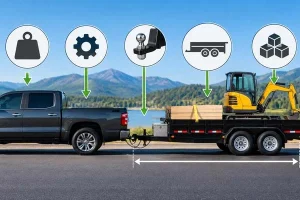
What Is a Custom Aluminum Car Trailer?

Car transport companies, motorsport teams, vehicle dealerships, repair shops, recovery businesses, distributors, and owners of classic or luxury cars are common buyers. These users often transport vehicles that do not fit standard trailer dimensions or require loading features unavailable on stock models.
What Makes a Car Trailer Custom?

A custom aluminum car hauler may also use removable ramps, folding ramps, a gravity tilt deck, or a hydraulic tilt system. Optional equipment can include a winch, toolbox, removable fenders, spare tire carrier, battery charger, and additional work lights.
Which Parts Can Be Made from Aluminum?

Buyers should confirm the material used for the tongue, main rails, crossmembers, deck, ramps, fenders, and reinforcement plates. This information makes quotations easier to compare and gives a clearer picture of the finished empty weight.
Mixed-material construction can be practical when properly engineered. Steel may be used at selected connection or high-wear points. Where steel and aluminum meet, the design should limit trapped moisture and reduce the risk of galvanic corrosion.
Why Choose an Aluminum Car Trailer?
Lower Empty Weight
Payload capacity = GVWR − empty trailer weight
Better Corrosion Resistance

An aluminum frame normally does not depend on paint, powder coating, electrophoretic coating, or hot-dip galvanizing for basic rust protection. It may still receive an optional finish for appearance or additional protection.
Corrosion resistance does not mean maintenance-free. Road salt, chemicals, mud, and trapped debris should still be removed. Mixed-metal joints and fasteners also need inspection because moisture and dissimilar materials can contribute to galvanic corrosion.
Reduced Load on the Tow Vehicle
Aluminum vs Steel Car Trailer: Which Is Better?
| Comparison Factor | Aluminum Car Trailer | Steel Car Trailer |
|---|---|---|
| Empty Weight | Usually lighter at a comparable size and rating | Usually heavier because of the higher material density |
| Corrosion Resistance | Does not develop red rust but still needs cleaning | Depends on paint, powder coating, or galvanizing |
| Initial Cost | Usually higher | Usually lower |
| Payload Potential | Lower empty weight may leave more usable payload | Higher empty weight may reduce available payload |
| Structural Repair | Requires aluminum welding experience | Easier to repair in many local workshops |
| Surface Maintenance | Usually requires less coating repair | Damaged coatings need prompt repair |
| Typical Use | Long-distance, coastal, humid, or premium vehicle transport | Rough work, heavy use, and budget-sensitive applications |
What Information Is Needed Before Customization?
An accurate quotation requires more than the car’s make and model. The manufacturer needs the vehicle dimensions, actual loaded weight, towing setup, destination, loading conditions, and preferred accessories.
Providing complete information at the beginning reduces drawing changes and helps the manufacturer select the correct structural and mechanical components.
Vehicle Dimensions
Loaded Weight and Ratings

Buyers should understand four important terms. Empty Weight is the weight of the completed trailer without cargo. Payload Capacity is the cargo weight the trailer can carry. GVWR is the maximum permitted weight of the loaded trailer.
According to the National Highway Traffic Safety Administration (NHTSA), GVWR is the loaded vehicle weight specified by the manufacturer and indicates how heavily the vehicle may be safely loaded.
Tongue Weight is the portion transferred to the tow vehicle through the coupler.
Gross Axle Weight Rating, or GAWR, must also be considered. It covers the rated capacity of the axle system, including the suspension, wheels, and tires. Axle capacity alone does not establish the safe payload of the complete trailer.
Tow Vehicle and Destination
Provide the tow vehicle’s model, towing capacity, hitch rating, receiver size, coupler type, hitch height, brake controller, and electrical connector.
The destination country or state affects maximum width, brake requirements, breakaway equipment, lighting, reflectors, safety chains, plugs, VIN documentation, and registration. International buyers should also discuss container-loading limits before the design is finalized.
How Should the Deck Be Customized?
Deck Size Versus Overall Size
Deck Size refers to the usable loading area. Overall Dimensions include the tongue, wheels, fenders, lights, and other projections.
Both measurements matter. The deck must fit the car, while the complete trailer must comply with road limits and fit through storage entrances, workshops, and shipping containers.
Choosing the Length and Width
Which Loading System Is Best?
Removable and Folding Ramps

Short ramps create a steeper approach angle. Longer ramps reduce that angle but require more storage space and can be difficult for one person to handle.
Folding ramps are faster to deploy because they remain attached to the trailer. However, large upright ramps can affect rear visibility and aerodynamic drag.
Tilt Loading Systems
Loading Low-Clearance Cars

Longer ramps may improve the approach angle but may not solve the breakover angle where the ramp meets the deck. A lower deck, longer transition, tilt deck, or drop-deck structure may be required.
The manufacturer should check the expected loading geometry during the drawing stage rather than waiting for the completed trailer to be tested with the car.
How Should Axles, Suspension, and Tires Be Selected?

Tandem axles are common on car trailers because they distribute the load across four tires and normally provide greater stability and braking capacity.
Straight axles with leaf springs are durable and widely serviceable. Torsion or swing-arm axles may provide a lower deck arrangement and independent wheel movement. Air suspension is usually reserved for specialized low-deck trailers.
What Braking and Safety Equipment Is Required?

Electric brakes are common on U.S.-style car trailers and work with a brake controller in the tow vehicle. Surge brakes use movement at the coupler to apply hydraulic braking. Heavier or specialized trailers may require other systems.
A breakaway system should activate the trailer brakes if the trailer separates from the tow vehicle. Its battery, switch, and cable must be inspected before travel.
Which Accessories Are Worth Adding?

A winch is useful for non-running, damaged, and low-clearance vehicles. Its capacity, reinforced mounting point, cable path, and power supply should be planned during the design stage.
Tie-down points and D-rings should be positioned around the actual tire locations. Their Working Load Limit and accessibility matter more than quantity. Wheel chocks help with positioning but do not replace rated restraints.
A toolbox can store straps, remotes, gloves, and maintenance equipment. Its weight and position must be considered because a large front-mounted toolbox can increase tongue weight.
Other practical options include removable fenders, a spare tire carrier, adjustable jack, battery charger, work lights, and hydraulic remote control.
How Is a Custom Aluminum Car Hauler Manufactured?
The manufacturer then prepares drawings showing the deck, overall dimensions, axle position, deck height, tongue, fenders, and loading structure. Production should begin only after the main specifications are approved.
Accurate cutting and forming improve component fit and frame alignment. During welding, the fabricator must control heat, sequence, penetration, and distortion. Reinforcement should follow the calculated load paths rather than being added only where the frame looks light.
How Should an Aluminum Trailer Be Maintained?
Aluminum reduces coating maintenance but does not remove the need for regular inspection. Wash off road salt, mud, and chemicals, especially after coastal or winter use.
Inspect the tongue, axle mounts, welds, ramp hinges, tie-down points, and hydraulic-cylinder mounts for cracks, looseness, or distortion. Structural damage should be assessed by a technician experienced in aluminum trailer repair.
Bearings, tires, brakes, suspension, wiring, jacks, and hydraulic parts require routine service. Before every trip, check the coupler, safety chains, lights, brakes, tire pressure, restraints, ramps, and deck locks.
Conclusion
FAQ
The correct answer to most trailer questions depends on the completed specification rather than frame material alone. Buyers should always compare ratings for equivalent trailers.
Is an Aluminum Trailer Strong Enough for an SUV?
Does an Aluminum Trailer Have a Higher Payload?
Is a Tilt Deck Better Than Ramps?
What Is Needed for an Accurate Quotation?
How Much Lighter Is an Aluminum Car Trailer Than Steel?
Share This Post
Lalune Teng
Lalune Teng is a seasoned expert in the trailer field with a passion for the trailer manufacturing industry, Lalune specializes in making the connection between innovative trailer solutions and the needs of the customer to help them find the perfect trailer to meet their needs, with over 5 years of professional experience. Lalune is responsible for creating educational and promotional content on car trailers, utility trailers, dump trailers and more. Her work highlights the company's dedication to quality and customization,. Contact Lalune through our latest articles where she shares knowledge, tips and updates on modern trailer solutions!
Table of Contents
Custom Your Trailers
Don’t hesitate to get in touch with us to explore our trailer and discuss how we can meet your unique requirements.
Find Your Trailer
Recently Posts


