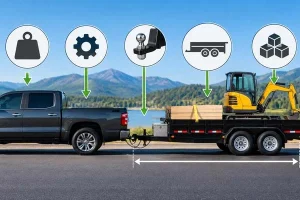
If you have ever tried to choose a trailer for your business or personal use, you probably ran into the same question: should I get a car trailer or an equipment trailer? At first, they can look almost identical. Both have flat decks, loading ramps, and similar towing setups, which makes the decision even more confusing.
The problem usually starts when buyers focus only on appearance or price instead of how the trailer will actually be used. A contractor might consider using a car trailer to move a skid steer, while a car dealer may look at an equipment trailer without realizing it is overbuilt for their needs.
What Is an Equipment Trailer
Before comparing the two directly, it helps to understand what an equipment trailer is designed to do in real-world use.
Definition and Core Purpose

An equipment trailer is built for hauling heavy machinery such as skid steers, excavators, tractors, and other industrial equipment. Its primary purpose is to handle high weight loads safely and consistently, even in demanding environments. Strength and durability are the main priorities, not convenience or lightweight design.
These trailers are commonly used in construction, agriculture, and industrial operations where reliability matters more than ease of use.
Typical Features
quipment trailers are constructed with a heavy-duty steel frame and reinforced crossmembers to support uneven and concentrated loads. The deck is designed to withstand pressure from machinery tracks or heavy wheels.
Most models include strong loading ramps or tilt systems that allow equipment to be driven or rolled onto the trailer. A higher GVWR is another key feature, giving the trailer the ability to carry heavier loads without compromising safety.
Common Use Cases

You will typically see equipment trailers on construction sites, where contractors move machinery between locations. They are also widely used in farming to transport tractors and agricultural tools. In industrial settings, they play a key role in moving heavy equipment that cannot be transported by standard vehicles.
What Is a Car Trailer
While an equipment trailer focuses on strength, a car trailer is designed with a completely different goal in mind.
Definition and Main Function

A car trailer is specifically designed to transport vehicles. When people ask what is a car trailer used for, the answer is straightforward: it is built to move cars safely and efficiently without causing damage during loading or transport.
These trailers are optimized for stability and smooth towing rather than maximum weight capacity.
Key Features
Car trailers typically have a lower deck height, which makes it easier to load vehicles, especially those with low ground clearance. This reduces the risk of scraping the underside of the car during loading.

They also include vehicle-specific securing systems such as tire straps or wheel nets, which hold the car in place without damaging it. Compared to an equipment trailer, a car trailer often uses lighter materials like aluminum or thinner steel to improve fuel efficiency and towing comfort.
Common Use Cases
When choosing a trailer, prioritize size, weight capacity, and durability. Safety features such as dependable brakes, solid hitches, and robust materials are essential. Additionally, evaluate the trailer’s storage options, insulation, and ventilation—particularly if you anticipate traveling in extreme weather conditions.
Equipment Trailer vs Car Trailer: Key Differences
Now that both types are clearly defined, the difference between car trailer and equipment trailer becomes much easier to understand. The table below summarizes the most important distinctions.
| Feature | Equipment Trailer | Car Trailer |
|---|---|---|
| Purpose | Heavy machinery | Vehicles |
| Weight capacity | Higher | Moderate |
| Deck design | Flat and reinforced | Lower and vehicle-friendly |
| Loading method | Ramps or tilt | Ramps or tilt optimized for cars |
| Suspension | Heavy-duty | Smoother ride |
| Typical users | Contractors, farmers | Car haulers, dealers |
The key takeaway from this comparison is that each trailer is optimized for a specific type of load, not for general use.
Load Capacity and Weight Differences
One of the most important differences in the equipment trailer vs car trailer comparison is how much weight each can handle.
Understanding GVWR and Payload Capacity

GVWR, or Gross Vehicle Weight Rating, refers to the maximum total weight a trailer can safely carry, including its own weight and the load. Payload capacity is the amount of cargo the trailer can handle after accounting for its own weight.
Equipment trailers are built with higher GVWR ratings, which means they can carry heavier loads without risking structural damage. This is why equipment trailer weight capacity is significantly higher than that of a car trailer.
Why Equipment Trailers Handle Heavier Loads
The design of an equipment trailer includes thicker steel, reinforced joints, and stronger axles. These features allow it to handle concentrated loads from heavy machinery without bending or failing.
Risks of Overloading a Car Trailer
Using a car trailer beyond its intended limits can lead to serious problems. The car trailer weight limit is designed for vehicles, not heavy equipment. Overloading can damage the frame, reduce braking performance, and increase the risk of accidents. The FMCSA safety standards clearly warn against exceeding load limits due to serious safety consequences.
Which One Should You Choose
The choice between a car trailer and an equipment trailer depends entirely on what you need to transport.

You primarily transport vehicles. You want easier loading and better fuel efficiency. You need a trailer designed specifically for vehicle safety and stability.

You regularly transport heavy machinery such as skid steers or tractors. You need a trailer that prioritizes strength and durability over convenience. Your work involves construction, agriculture, or industrial operations.
Common Mistakes Buyers Make
One of the most common mistakes is using a car trailer for heavy equipment. This can lead to structural damage and serious safety risks.
Another mistake is ignoring GVWR and payload limits. Overloading a trailer reduces its lifespan and increases the risk of accidents.
Some buyers also focus only on price, choosing a cheaper option without considering whether it is suitable for their needs. Others fail to check the towing capacity of their vehicle, which is just as important as the trailer itself.
Case Study
A contractor moving a skid steer between job sites will benefit from an equipment trailer because of its higher load capacity and durability.
A car dealer transporting multiple sedans will find a car trailer more practical, as it provides better stability and protection for vehicles.
A farm owner transporting tractors or tools will need an equipment trailer to handle the weight and rough conditions.
Conclusion
FAQ
Can I use a car trailer to haul equipment
It is possible to use a car trailer for very light equipment, but it is not recommended for heavy machinery. Exceeding the trailer’s capacity can cause damage and create safety hazards. For regular equipment transport, an equipment trailer is the safer choice.
What is the main difference between an equipment trailer and a car trailer
Which trailer is better for a skid steer
Are car trailers lighter than equipment trailers
What size trailer do I need for transporting a car
Share This Post
Lalune Teng
Lalune Teng is a seasoned expert in the trailer field with a passion for the trailer manufacturing industry, Lalune specializes in making the connection between innovative trailer solutions and the needs of the customer to help them find the perfect trailer to meet their needs, with over 5 years of professional experience. Lalune is responsible for creating educational and promotional content on car trailers, utility trailers, dump trailers and more. Her work highlights the company's dedication to quality and customization,. Contact Lalune through our latest articles where she shares knowledge, tips and updates on modern trailer solutions!
Table of Contents
Custom Your Trailers
Don’t hesitate to get in touch with us to explore our trailer and discuss how we can meet your unique requirements.
Find Your Trailer
Recently Posts


