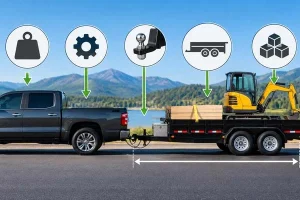
The right car trailer size should be chosen around the vehicle you need to haul, the way you load it, the roads you drive on, and the space you have for storage. Many buyers only ask whether the car can fit on the deck, but that is not enough. A car may fit by length, yet still leave poor tie-down angles, tight fender clearance, a steep loading angle, or unsafe weight balance. That is why choosing a car trailer is closer to choosing work equipment than buying a simple steel platform with wheels. If the size is wrong, every loading job becomes slower, riskier, and more stressful.

For most buyers, a 16 ft car trailer can work for compact cars and many sedans, an 18 ft car trailer is often a better all-around choice, and a 20 ft car trailer is usually more practical for SUVs, pickup trucks, longer cars, and mixed-use hauling. But that does not mean every buyer should run straight to the largest model. A longer trailer costs more, weighs more, needs more towing capacity, takes up more space, and can be harder to turn in narrow yards or driveways. The goal is not to buy the biggest trailer in the catalog. The goal is to buy enough usable deck length, enough deck width, and enough payload capacity for your real job.
If you are comparing car trailer sizes for a personal vehicle, repair shop, dealership, farm, race car, or equipment hauling use, the key is to think in real-world terms. Can the vehicle drive onto the trailer without scraping? Can the driver open the door after loading? Do the tires clear the fenders? Is there enough space to strap the vehicle from safe angles? Can your tow vehicle handle the total loaded weight? Can you store the trailer without blocking your yard or warehouse entrance? These are the questions buyers actually face after delivery, and they matter more than a simple size label such as 16 ft or 18 ft.
If you want a fast answer, start with the vehicle type and then confirm the actual vehicle dimensions. Small cars usually need less deck length, but low ground clearance may require better ramps or a lower deck. Sedans often fit on 16 ft trailers, but 18 ft gives more room for safer load placement. SUVs and pickup trucks usually need more width and may benefit from an 18 ft or 20 ft deck. For business buyers who haul different vehicles every week, flexibility matters more than saving a small amount on the trailer length.
| Trailer Size | Best For | Why Buyers Choose It | Main Risk |
|---|---|---|---|
| 14 ft car trailer | Small cars, compact vehicles, short local hauling | Easy to store, lighter to tow, lower cost | Limited room for tie-downs and load balance |
| 16 ft car trailer | Compact cars, many sedans, light personal use | A practical size for many everyday cars | Can feel tight for longer sedans or SUVs |
| 18 ft car trailer | Sedans, small SUVs, light trucks, mixed personal use | Better balance between size, price, and flexibility | Still needs careful width and payload checks |
| 20 ft car trailer | Pickup trucks, SUVs, longer cars, business hauling | More room for positioning, tie-downs, and future use | Needs more storage space and towing capacity |
| 22 ft to 24 ft car trailer | Long trucks, specialty vehicles, frequent commercial use | Maximum loading flexibility for larger jobs | Higher cost, more weight, wider turning space |
This table is useful, but it should not replace measurement. A 16 ft trailer from one factory and a 16 ft trailer from another factory may not feel the same during loading. One may have a lower deck, longer ramps, removable fenders, and better tie-down points. Another may have fixed fenders, a steeper loading angle, and less usable room at the front because of a winch plate or toolbox. When comparing car trailer size, always ask for usable deck length, usable deck width, width between fenders, deck height, ramp length, axle rating, and payload capacity. These details tell you how the trailer will work after it arrives.
Car trailer size usually refers to deck length, but deck length alone does not tell the full story. When a seller says a trailer is 18 ft, that normally means the loading deck is about 18 ft long. It does not always tell you the total trailer length including the tongue, coupler, rear ramps, dovetail, or spare tire position. It also does not tell you whether the full deck width is usable. For buyers, this is where confusion starts. A trailer can look large in photos but feel narrow when a wide vehicle is loaded between fixed fenders.
A smart buyer should treat car trailer size as a group of measurements, not one number. Deck length tells you how much front-to-back loading room you have. Deck width tells you how much tire and body clearance you have. Fender spacing tells you whether the vehicle can actually pass between the fenders. Deck height and ramp length tell you how steep the loading angle will be. Overall length tells you how much space you need for storage and turning. Payload capacity tells you whether the trailer can carry the vehicle safely. If one of these numbers is wrong, the trailer may not be suitable, even if the deck length sounds right.
Deck length is the first number most buyers compare because it decides whether the vehicle can sit on the trailer from front to back. For a compact car, a shorter deck may be enough. For a midsize sedan, SUV, pickup, classic car, or race car, extra length can make loading much easier. The key point is not only whether the tires fit on the deck. You also need room for tie-down straps, safe loading position, and proper weight distribution over the axles. If a vehicle barely fits, you may have very little control over where the weight sits, and that can affect towing stability.
A slightly longer deck gives you room to move the vehicle forward or backward to improve tongue weight. This matters because too much weight at the tongue can overload the tow vehicle, while too little tongue weight can cause sway. A trailer that gives you only one possible loading position is less forgiving. For this reason, buyers who regularly haul different vehicles often choose an 18 ft or 20 ft car trailer instead of a smaller model. The extra length is not just for fitting longer cars. It gives the driver more control over balance, tie-down position, and loading comfort.
Deck width is one of the most overlooked parts of car trailer size. Many buyers see the outside width and assume the trailer is wide enough, but the real question is how much usable width exists between the fenders or on the driving surface. A trailer with fixed side fenders may be difficult for wide vehicles, even if the total outside width looks large. If the tires pass close to the fenders, loading becomes stressful. If the door cannot open after loading, the driver may have to climb out of the window or load the vehicle in an awkward way. That is not something you want to discover after purchase.
For SUVs, pickup trucks, wide sports cars, modified cars, and vehicles with larger wheels, fender design deserves close attention. Removable fenders help because the driver can open the door more easily after loading. Drive-over fenders help when the vehicle is wide enough that the tires may need to pass over the fender area. Full-width deck designs may be useful for buyers who haul many vehicle types. If your work involves different cars every week, a wider and more flexible deck can save far more time than a slightly longer deck. Length gets the attention, but width often decides whether the trailer feels easy or difficult to use.
Overall length is different from deck length, and it matters more than many first-time buyers expect. A trailer with a 20 ft deck may be much longer once you include the tongue, coupler, ramps, rear structure, and front accessories. If you plan to store the trailer at home, behind a workshop, inside a warehouse, or in a rented yard, the total length should be checked before ordering. A trailer that fits the vehicle but does not fit your storage area can become an everyday problem. You may also need extra room behind the trailer for lowering ramps and loading the car.
Overall length also affects turning and reversing. A longer trailer may track more smoothly on the road, but it needs more space in tight places. If you often work in narrow repair yards, dealership lots, rural entrances, or crowded job sites, the biggest trailer may slow you down. For experienced haulers, this may not be a serious issue. For new buyers, it can become a daily headache. Before choosing a longer car trailer, picture where it will turn, where it will park, where it will load, and how much space the driver has to correct the angle when reversing.
Deck height affects loading more than it appears on paper. A higher deck usually creates a steeper ramp angle, especially if the ramps are short. That may not matter for a truck or SUV with good ground clearance, but it can be a serious problem for a low car, sports car, race car, or vehicle with a front lip. When the angle is too steep, the bumper, exhaust, side skirt, or underbody may scrape before the tires reach the deck. Buyers sometimes blame the trailer length, when the real issue is deck height and ramp angle.
If you haul low-clearance vehicles, ask about ramp length, ramp width, beavertail design, dovetail angle, tilt deck options, and deck height. A low deck trailer or tilt car trailer can make loading much smoother because the transition angle is softer. For general-purpose work, a higher deck may be acceptable, especially when ground clearance on rough roads is more important. The right choice depends on the vehicles you move most often. A race car buyer and a farm buyer may both need a car trailer, but they should not automatically choose the same deck height.
Most open car trailers fall into a few common size groups, but the best size depends on how you use the trailer. A private buyer who hauls one sedan a few times per year may be happy with a smaller trailer. A repair shop that moves different customer cars may need an 18 ft or 20 ft model because the work changes every day. A trailer dealer, rental company, or overseas importer may care even more about size because customer needs vary and product returns are expensive. Size should be matched to the job, not chosen by habit.
Another important point is future use. Buyers often shop for the vehicle they own today, then need to haul a different vehicle later. Maybe you buy the trailer for a compact car, but later use it for an SUV, pickup, classic car, or small equipment. If you already know your hauling needs may change, it is usually safer to choose a size with a little more room. That does not mean wasting money on a huge trailer. It means leaving enough margin so the trailer remains useful when the job changes.
A 14 ft car trailer can work for small cars, compact vehicles, and light local hauling where storage space is limited. It is often easier to park, easier to tow, and less expensive than larger trailers. For a buyer who only moves a small car occasionally, this size may feel simple and efficient. It can also be attractive when the tow vehicle is not strong enough for a heavier trailer. If your goal is short-distance personal use with a small vehicle, a 14 ft trailer can be a practical choice.
The problem is that a 14 ft trailer gives very little extra room. Tie-down angles may be tight, vehicle positioning may be limited, and longer cars may not fit comfortably. If the trailer has fixed fenders, a high deck, or short ramps, loading may feel more difficult than expected. A small trailer can save money at purchase, but it can also limit what you can haul later. Before choosing this size, measure your vehicle carefully and think about future needs. If there is a real chance you will haul a sedan, SUV, or project vehicle later, moving up to 16 ft or 18 ft may be a safer decision.
A 16 ft car trailer is a common choice for personal use because it fits many compact cars and sedans while staying manageable for storage and towing. For buyers who want a simple open trailer for occasional vehicle transport, 16 ft often looks like the natural starting point. It is not too large for most driveways, and it does not feel as demanding as a 20 ft trailer. If the trailer has a good ramp design, enough usable width, and suitable payload capacity, it can be a strong choice for many everyday cars.
However, 16 ft can become tight when the vehicle is long, low, wide, or heavy. Many modern cars are larger than buyers expect, and even a sedan can take up much of a 16 ft deck. When there is not enough extra room, strap angles may become poor and load balance may be harder to adjust. If you only haul one known vehicle and the measurements work, 16 ft may be fine. If you want a trailer for mixed vehicles, an 18 ft car trailer often gives a better working margin without becoming much harder to tow.
An 18 ft car trailer is often the most balanced size for buyers who want flexibility without going too large. It gives more room than a 16 ft trailer for vehicle placement, tie-down access, and front accessories such as a winch or toolbox. For sedans, small SUVs, light trucks, race cars, project cars, and general vehicle hauling, 18 ft often feels more comfortable in daily use. It gives the buyer a useful margin without requiring as much storage and turning space as a much longer trailer.
This size is especially useful when you do not always know what you will haul next. A repair shop, small dealer, motorsport user, or farm owner may load different vehicles throughout the year. The extra 2 ft compared with a 16 ft deck can make loading less stressful and give more room to adjust tongue weight. The main thing is to check width and payload at the same time. An 18 ft trailer with poor fender clearance may still be a bad choice for wide vehicles. A good 18 ft trailer should offer enough length, enough usable width, proper axle rating, and practical loading features.
A 20 ft car trailer is a strong option for buyers who haul pickup trucks, SUVs, longer cars, or mixed vehicles often. The extra length gives more freedom to position the vehicle correctly over the axles, which can improve towing stability. It also gives more space for tie-downs, winches, spare tires, and toolboxes. For business buyers, that flexibility can be more important than the higher purchase price because the trailer can handle more jobs with fewer compromises.
The trade-off is that a 20 ft trailer is larger, heavier, and more demanding. It needs more storage space and a capable tow vehicle. It may cost more to ship, maintain, and operate. If you only haul a small car once in a while, a 20 ft trailer may be more than you need. But if you frequently haul SUVs, trucks, customer vehicles, or vehicles with longer wheelbases, this size often makes sense. The buyer should check total loaded weight carefully because trailer size and trailer payload are not the same thing. A long trailer that cannot safely carry the vehicle weight is still the wrong trailer.
A 22 ft to 24 ft car trailer is usually chosen for commercial use, specialty vehicles, long trucks, race teams, or buyers who want maximum deck flexibility. This size gives plenty of room for load placement, tie-down angles, and extra equipment. If the trailer is built with the right axle rating and deck structure, it can serve buyers who need to haul larger or less predictable loads. For some businesses, a longer trailer reduces the chance of turning down a job because the vehicle is too long.
At the same time, this size should not be chosen casually. A longer trailer needs more skill, more space, and more towing capacity. It may be harder to reverse into tight areas, and it may be overkill for personal use. The empty trailer weight also increases, which can reduce available payload if the gross vehicle weight rating does not rise enough. Before buying a 22 ft or 24 ft trailer, buyers should be clear about why they need the length. If the extra deck space solves a real work problem, it can be a good investment. If it is only chosen because bigger sounds safer, it may create unnecessary cost and inconvenience.
The safest way to choose car trailer size is to measure the vehicle first, then choose the trailer. Start with the vehicle length, overall width, tire track width, ground clearance, wheelbase, curb weight, and any added accessories. Do not rely only on labels such as sedan, SUV, or pickup. Two SUVs can have very different lengths and widths. Two cars in the same category can have different front overhangs and loading needs. The tape measure tells the truth faster than a product name.
After measuring the vehicle, compare it with the trailer’s usable deck length, usable width, fender spacing, ramp length, deck height, and payload capacity. You want enough length for the tires and safe positioning, enough width for loading without rubbing, and enough payload for the vehicle plus accessories. Do not forget spare tires, ramps, winches, toolboxes, fuel, cargo inside the vehicle, and added parts. In real use, the load is rarely just the empty vehicle. Small details can push the total weight higher than expected.
For compact cars and many sedans, 16 ft to 18 ft is usually the practical range. A compact car may fit on a 14 ft trailer, but 16 ft often gives more comfort. A midsize sedan may fit on 16 ft, but 18 ft gives more room for better balance and easier tie-down access. If the car has low ground clearance, the ramp angle becomes just as important as the deck length. A low car can scrape on a poorly designed trailer even when the deck is technically long enough.
Sedan buyers should pay attention to front overhang and door clearance. A car with a long front bumper may need a smoother ramp transition. A trailer with high fixed fenders may make it hard to open the driver door after loading. If you plan to haul the same sedan again and again, you can choose based on that exact vehicle. If the trailer may be used for different cars, 18 ft gives more flexibility. For personal users, that extra space can make loading feel calmer. For business users, it can save time and reduce customer vehicle handling problems.
SUVs and pickup trucks need closer attention because they are often longer, wider, and heavier than sedans. For many of these vehicles, 18 ft to 20 ft is a more realistic starting point. A full-size pickup or larger SUV may need a 20 ft trailer for better load position and safer tie-down angles. Width is also critical. The vehicle may fit by length, but if the tires are close to the fenders, loading can become slow and stressful. Wide mirrors, running boards, large tires, and lifted suspensions can also change the loading experience.
Payload capacity is another major issue for trucks and SUVs. A trailer may be long enough but still not rated to carry the load safely. Buyers should compare the trailer payload capacity with the actual vehicle weight, not just the trailer’s deck size. If the vehicle is loaded with tools, fuel, accessories, or cargo, the weight can be higher than the factory curb weight. For frequent SUV and pickup hauling, a stronger axle setup, good brakes, proper tires, and strong tie-down points are just as important as deck length. Size gets the vehicle on the trailer. Strength keeps the job safe.
Low cars need more than a normal size check. A race car, sports car, classic car, or modified street car may have a low front lip, side skirt, long overhang, or stiff suspension. Even if the deck length is correct, the car may scrape when climbing the ramps. For this reason, buyers hauling low cars should ask about loading angle before asking only about trailer length. A lower deck, longer ramps, dovetail design, or tilt deck may be needed to make loading safe and repeatable.
For race car users, extra deck space can also be useful for tools, spare wheels, fuel containers, and equipment, but weight must still be managed carefully. A trailer that carries both the car and support gear needs enough payload capacity. Tie-down points should be easy to reach, especially if the car sits low and access underneath is limited. Removable fenders are often useful because they help the driver get out after loading. If the car is valuable, the right trailer size is not just about convenience. It protects the vehicle from damage during every loading and unloading cycle.
Road rules matter because trailer width, lighting, braking, registration, and load securement can affect legal use. In many U.S. road transport settings, 102 inches, or 8 ft 6 in, is a common maximum vehicle width reference for major routes. However, local rules can vary depending on state, road type, trailer use, commercial status, and permits. Buyers outside the United States should check their own country’s trailer width, brake, lighting, registration, and towing rules before placing an order. For importers and distributors, this step is not optional. A trailer that sells well in one market may need design changes for another market.
Road legality also connects with practical driving. A wide trailer may be easier to load, but it can be harder to drive through narrow streets, rural gates, warehouse entrances, or crowded parking areas. A long trailer may tow smoothly on open roads, but it may require more turning space. Buyers should think about the real routes they use, not just highway conditions. If your trailer will move through farms, construction areas, auction yards, ports, or repair shop lots, size should be chosen with those places in mind. Good trailer design is not only about the open road. It is about the awkward places where loading and turning really happen.
Storage is one of the most practical parts of choosing a car trailer size. A buyer may focus on the vehicle being hauled and forget where the trailer will sit when it is not being used. Before buying, measure the storage area carefully. Include the full trailer length, tongue, ramps, fenders, and any front toolbox or winch mount. Also leave room to walk around the trailer, inspect tires, connect the tow vehicle, and lower the ramps. A trailer that barely fits into storage can become annoying very quickly.
For home users, driveway length and neighborhood parking rules may influence the choice. For shops and dealers, yard layout and turning lanes matter. For farms and industrial users, gate width and ground condition may be more important. For importers, container loading and shipping dimensions may affect which trailer size is most profitable. A trailer is not only used when a car is on it. It occupies space every day. Choosing the right size means thinking about both working time and parked time.
Car trailer size should never be separated from towing capacity. A longer trailer is usually heavier, and the vehicle loaded on it may be much heavier than expected. To choose safely, buyers need to understand trailer empty weight, gross vehicle weight rating, payload capacity, tongue weight, and the tow vehicle’s rated towing limit. The trailer must be strong enough to carry the load, and the tow vehicle must be strong enough to control the trailer. Braking, suspension, tires, hitch rating, and weight distribution all matter.
A common mistake is choosing the trailer only by deck size and later discovering that the payload is not enough. For example, a trailer may have the right length for a pickup truck but not enough axle rating to carry it safely. Another mistake is ignoring the weight of accessories. Ramps, spare tire, winch, toolbox, tie-down gear, and cargo inside the hauled vehicle all add weight. If you are buying for business use, leave a safety margin. A trailer that works at its limit every day will wear faster and create more risk. A properly sized car trailer should match both the vehicle dimensions and the vehicle weight.
Material can affect the practical size choice. Steel car trailers are often chosen for strength, durability, and cost control. They are common for work use, farm use, dealership hauling, and heavy-duty applications. Aluminum car trailers are often lighter, which can help with towing capacity and corrosion resistance, but they may cost more. The size question does not disappear when material changes. A 20 ft aluminum trailer may be lighter than a similar steel trailer, but you still need to check deck width, payload rating, ramp design, and tie-down layout.
For buyers who haul heavier vehicles or work in rough conditions, steel may feel more reassuring because of its strong structure and repairability. For buyers who care about lower empty weight and long-distance towing, aluminum may be attractive. The right answer depends on budget, vehicle weight, road conditions, corrosion exposure, and how often the trailer is used. Do not choose material before confirming size. First decide what the trailer must carry and how it must load. Then compare steel and aluminum designs that meet those requirements.
The best way to avoid a wrong purchase is to stop thinking of car trailer size as a single number. Before ordering, write down the largest vehicle you plan to haul, the widest vehicle you may haul, the lowest vehicle you may haul, and the heaviest vehicle you may haul. These may not be the same vehicle. A low sports car creates ramp problems. A wide pickup creates fender clearance problems. A heavy SUV creates payload problems. A long classic car creates deck length problems. Your trailer needs to handle the toughest realistic combination.
When speaking with a supplier, ask practical questions. What is the usable deck length? What is the usable deck width? What is the space between fenders? Are the fenders removable? What is the deck height? What is the ramp length? What is the payload capacity? What axle and brake system is used? Where are the tie-down points placed? Can the trailer be customized for wider vehicles, lower loading angle, or different ramp styles? A reliable supplier should be able to answer these questions clearly. If the answer is only “standard size,” keep asking. Standard does not always mean suitable.
A checklist keeps the buying process honest. It helps you compare trailers by function instead of photos or price alone. This is especially important for B2B buyers, because one wrong size decision can affect many users. A dealer may need a trailer that works for many vehicle types. A rental company needs a trailer that is easy for customers to use. A workshop needs a trailer that saves time instead of creating loading problems. A farm buyer may need a trailer that handles uneven ground and mixed equipment. The right checklist turns a broad question into a clear decision.
- Measure the longest vehicle you expect to haul, including overhangs.
- Measure the widest vehicle, including tire width and body clearance needs.
- Check the lowest vehicle ground clearance and front bumper height.
- Confirm the trailer usable deck length, not only the advertised size.
- Confirm the usable deck width and width between fenders.
- Ask whether the fenders are fixed, removable, or drive-over style.
- Check ramp length, ramp width, and loading angle.
- Compare vehicle weight with real trailer payload capacity.
- Check tie-down point location and strap access.
- Measure storage space, turning space, and loading space.
If a trailer passes this checklist, it is much more likely to work well after delivery. If it fails on one important point, do not ignore it just because the price looks good. A trailer that is too short, too narrow, too steep, or too weak will cost time and money later. Good buyers do not only ask, “How much is the trailer?” They ask, “Will this trailer make loading safer, faster, and easier for the vehicles I actually move?” That question leads to a better purchase.
For general use, an 18 ft car trailer is often the most practical choice because it gives more room than a 16 ft trailer without becoming as large as a 20 ft or 24 ft trailer. It can handle many sedans, small SUVs, light trucks, and project cars when the width and payload capacity are suitable. Buyers who only haul compact cars may be fine with 16 ft, while buyers who often haul pickups or larger SUVs may prefer 20 ft. The best general-use size should leave enough room for vehicle positioning, safe tie-down angles, and future hauling needs.
A 16 ft car trailer can be big enough for many sedans, but it depends on the actual sedan length, ground clearance, and trailer design. Some sedans are longer than buyers expect, and a car that technically fits may still leave poor tie-down access or limited room for weight balance. If the trailer has good ramps, suitable width, and enough payload, 16 ft may work well for personal use. If you want more comfort or plan to haul different cars, 18 ft is usually easier to live with.
For many pickup trucks, an 18 ft to 20 ft car trailer is a better starting point, with 20 ft often being more comfortable for full-size trucks. Pickup trucks are usually longer, wider, and heavier than sedans, so the buyer must check deck length, width between fenders, payload capacity, axle rating, and brake system. If the truck has large tires, a lift kit, running boards, or a long wheelbase, the trailer may need more width and stronger ramps. Do not choose based on length alone. Make sure the trailer can carry the weight safely.
A car trailer should be wide enough for the vehicle tires and body to clear the deck and fenders safely. The most important number is not always the outside width. The buyer should ask for usable deck width and width between fenders. For compact cars and sedans, many standard trailers may work. For SUVs, pickup trucks, wide sports cars, or modified vehicles, removable fenders, drive-over fenders, or a wider deck may be needed. If the vehicle barely clears the fenders, loading will be stressful and may damage the trailer or vehicle.
A longer car trailer is not always better. Extra length can help with load placement, tie-down angles, and future flexibility, but it also adds weight, cost, storage needs, and turning space. A 20 ft trailer may be smart for trucks, SUVs, and business hauling, but it may be unnecessary for someone who only moves one compact car a few times per year. The best size is the smallest trailer that still gives enough working room, enough payload, and enough safety margin for your real use.
Deck length is the usable loading area where the vehicle sits. Overall trailer length includes the deck plus the tongue, coupler, ramps, rear structure, and sometimes front accessories. A trailer advertised as 18 ft may need much more than 18 ft of storage space. This matters for driveways, warehouses, yards, shipping, and turning space. Buyers should always ask for both numbers. Deck length tells you whether the vehicle can sit on the trailer. Overall length tells you whether the trailer fits your property and transport plan.
Low cars usually need more attention to loading angle than simple deck length. A 16 ft or 18 ft trailer may be long enough, but if the deck is high and the ramps are short, the car may scrape during loading. For sports cars, race cars, classic cars, and modified vehicles, a lower deck, longer ramps, dovetail design, or tilt trailer may be a better choice. Buyers should ask about deck height and ramp angle before ordering. For low cars, a trailer that loads smoothly is safer than a trailer that only looks correct by length.
Yes, one trailer can sometimes work for both cars and equipment, but only if the deck size, ramp strength, payload capacity, and tie-down layout match both uses. A trailer used for cars may need gentle ramps and fender clearance. A trailer used for equipment may need stronger ramps, a tough deck, and different tie-down points. If you plan to haul cars, UTVs, small machinery, or farm equipment on the same trailer, an 18 ft or 20 ft model may offer better flexibility. The supplier should understand the full use case before recommending a design.
Choosing the right car trailer size starts with the vehicle, but it should not stop there. A good trailer must have enough deck length, enough usable width, suitable fender clearance, safe ramp angle, proper payload capacity, and enough space for tie-downs. A 16 ft car trailer may be right for many sedans and compact cars. An 18 ft car trailer is often the most flexible choice for personal and mixed use. A 20 ft car trailer is usually better for SUVs, pickup trucks, longer cars, and business hauling. Larger 22 ft to 24 ft trailers can be useful for commercial work, but they need more towing power, more storage space, and more driving skill.
The best advice is simple: do not buy by the size label alone. Measure the vehicle, check the usable trailer dimensions, confirm the payload capacity, and think about how the trailer will be loaded, towed, parked, and stored. A trailer that barely fits the vehicle may still create daily problems. A trailer with the right working margin will feel safer, faster, and more useful every time you load it. That is the real value of choosing the correct car trailer size before you buy.