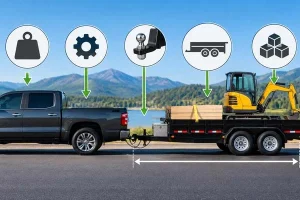
A car trailer frame decides how safe, stable, and useful the trailer will be long after the paint starts to fade. When buyers compare car trailers, they often look at ramps, deck length, tire size, lights, and price first. Those details matter, but the frame is the part that carries the load, absorbs road shock, handles turning force, and keeps the trailer straight behind the tow vehicle. If the frame is too light, poorly welded, or not matched to the type of vehicle you plan to haul, the trailer may feel unstable on the road even when it looks fine in the yard. For anyone choosing a car hauler for daily vehicle transport, race car towing, equipment delivery, or farm use, understanding the car trailer frame is one of the smartest buying steps you can take.

Think of the trailer frame like the foundation of a warehouse. You do not see every beam once the building is finished, but the whole structure depends on it. A trailer works the same way. The main rails, crossmembers, tongue, coupler area, axle mounts, and rear loading section all work together. When these parts are designed well, the trailer tracks smoothly, loads evenly, and lasts longer under real road conditions. When these parts are designed poorly, problems usually show up as frame flex, cracked welds, uneven tire wear, rust around stress points, or a trailer that feels nervous at highway speed. That is why a strong car trailer frame is not just a technical detail. It is a safety decision, a maintenance decision, and a long-term cost decision.
The biggest reason the car trailer frame matters is simple: it controls how the trailer handles weight while moving. A parked trailer may look strong, but towing tells the real story. During transport, the frame is dealing with vehicle weight, road vibration, braking force, side wind, ramp loading pressure, and small twists from uneven ground. A well-built frame spreads those forces across the whole structure instead of letting one weak area take too much stress. This is especially important when hauling heavier vehicles such as pickup trucks, SUVs, classic cars, or machinery. A trailer that is close to its limit every time it is loaded will age much faster than a trailer built with enough structural margin.
A strong car trailer frame also helps protect the vehicle being hauled. If the trailer flexes too much, the deck can move unevenly while the car is strapped down. That movement may loosen tie-downs, stress the suspension of the transported vehicle, or create a rougher ride over long distances. For commercial haulers, this can affect customer trust. For private owners, it can turn a simple trip into a stressful drive. A stronger frame does not mean the trailer has to be oversized for every job, but it does mean the design should match the load. If you haul a 3,200 lb sedan twice a month, your needs are different from someone moving a 6,500 lb truck every week.
A car trailer frame is more than two long steel beams under the deck. The main rails carry much of the lengthwise load, but the crossmembers support the deck and help spread vehicle weight from side to side. The tongue connects the trailer to the tow vehicle and handles heavy pulling, braking, and turning force. The axle mounting area carries repeated impact from road shock. The rear frame section must handle the extra stress created when a vehicle drives up the ramps. If one of these areas is underbuilt, the whole trailer can suffer even if the rest of the structure looks strong.
When you inspect a trailer, look at how these frame sections are connected. Clean welds, even spacing, gussets in high-stress areas, and reinforced tongue construction are signs of better workmanship. A trailer may have thick main rails, but if the crossmembers are spaced too far apart or the tongue is not properly braced, it may still feel weak under load. This is why smart buyers do not judge a car trailer frame by one number alone. Frame thickness, material type, weld quality, beam shape, crossmember spacing, and load rating all need to make sense together.
For most buyers, the choice comes down to steel or aluminum. A steel car trailer frame is usually stronger for the price, easier to repair, and better suited for rough commercial use. Steel handles concentrated loads well, which is why many heavy-duty car haulers, equipment trailers, and tilt trailers still use steel frames. The downside is weight and corrosion. A steel trailer is heavier, which can reduce payload capacity and increase fuel use. It also needs good coating, cleaning, and maintenance to prevent rust, especially in wet climates or places where roads are salted in winter.
An aluminum car trailer frame is lighter and more resistant to corrosion. That makes it attractive for race car owners, collectors, and long-distance towing users who care about fuel economy and easier handling. A lighter trailer can also reduce strain on the tow vehicle. However, aluminum usually costs more upfront, and repairs may require more specialized skills. It can be a smart choice when corrosion resistance and lower trailer weight are top priorities, but it may not be the best fit for buyers who regularly haul heavy machinery, scrap vehicles, or rough farm loads. The better question is not whether steel or aluminum is always better. The better question is which material fits your daily use, budget, climate, and maintenance habits.
| Frame Material | Best For | Main Advantage | Main Concern |
|---|---|---|---|
| Steel frame | Heavy vehicles, equipment hauling, commercial use | High strength and easier repair | Needs rust protection and regular inspection |
| Aluminum frame | Race cars, collector cars, long-distance towing | Lighter weight and better corrosion resistance | Higher cost and more specialized repairs |
| Galvanized steel frame | Wet regions, coastal use, outdoor storage | Better corrosion resistance than painted steel | Usually costs more than standard painted steel |
A tube frame trailer uses square or rectangular tubing for the main structure. This design often gives the trailer a clean appearance and good resistance to twisting. Because the tube is closed on all sides, it can feel rigid and smooth during towing when built correctly. Many enclosed car trailers and premium open car haulers use tube construction because it supports a neat chassis layout and can help create a strong deck structure. For buyers who want a trailer that feels solid on the road and looks more finished underneath, tube frame construction can be appealing.
The main concern with tube frames is hidden corrosion. If water gets inside the tubing through small gaps, drilled holes, or imperfect welds, rust can begin where you cannot see it. This matters most for buyers who store trailers outside or tow in rain, snow, or salty road conditions. A tube frame is not a bad choice, but it should be inspected carefully. Look for drain points, sealed welds, coating quality, and any signs of swelling or rust stains near joints. If you buy a used tube frame trailer, spend extra time checking the underside because inside-out rust can be harder to catch early.
A channel frame trailer uses C-channel steel for the frame rails and sometimes for crossmembers. This style is common because it is practical, repairable, and cost-effective. One real advantage of channel steel is that moisture does not get trapped inside the beam the same way it can with tube steel. You can usually see rust earlier, clean the frame more easily, and repair damaged sections with less trouble. For buyers who want a working trailer for cars, small equipment, farm tasks, or occasional transport, a well-built channel frame can be a sensible choice.
The key is to avoid assuming that every channel frame trailer is built the same. A heavy channel frame with proper crossmember spacing can perform very well, while a thin channel frame with wide spacing may flex too much. Check the steel size, GVWR, axle setup, and weld quality before judging the trailer. If the trailer will carry heavy vehicles often, ask whether the frame has added reinforcement near the tongue, spring hangers, and rear loading area. A channel frame can be dependable, but only when the design matches the load.
An I-beam car trailer frame is often found on heavier-duty trailers because the shape is efficient at resisting bending. The beam puts more material where stress is higher, which helps create strength without making every part unnecessarily thick. This is why I-beam construction is common in bridges, industrial buildings, and heavy trailer frames. For buyers hauling heavier cars, trucks, or equipment, an I-beam frame can provide a better balance of strength, stiffness, and durability. It is especially useful when the trailer needs to handle repeated commercial use rather than occasional weekend towing.
A good I-beam frame should still be judged as a complete system. The beam shape is strong, but the trailer also needs proper crossmembers, strong suspension mounts, a reinforced tongue, and clean welds. Some buyers hear the term I-beam and assume the trailer is automatically heavy-duty. That is not always safe. A poorly built trailer with I-beam rails can still fail if the connection points are weak. If you are comparing trailers, look at how the frame rails connect to the tongue and axle area. Those transition points often reveal whether the trailer was built for real work or just marketed as heavy-duty.
Frame thickness matters, but it should not be the only thing you check. A thicker car trailer frame can resist bending better and may last longer under heavy loads. However, trailer strength comes from the whole design, not just steel thickness. Beam shape, frame height, crossmember spacing, weld quality, gusset placement, axle position, and deck support all affect performance. A trailer with smart engineering can sometimes outperform a heavier trailer that simply uses more steel in the wrong places. That is why buyers should compare actual specifications instead of relying on a quick visual impression.
The best way to think about frame thickness is to match it with the trailer’s job. If you haul small cars on paved roads a few times a year, you may not need the heaviest frame available. If you haul trucks, tractors, construction machines, or vehicles over long distances, you should look for stronger main rails, reinforced loading areas, and a frame rating with enough safety margin. Do not buy a trailer that will live at its maximum rating every time you use it. Constantly pushing the frame to its limit increases wear, raises maintenance risk, and can make towing less comfortable.
Crossmember spacing has a direct effect on deck support and frame stiffness. Crossmembers are the smaller beams that run across the trailer from one side to the other. They support the deck, distribute vehicle weight, and help prevent twisting. If the spacing is too wide, the deck may feel soft, the frame may flex more, and heavy tire contact points may stress the structure over time. This matters when loading vehicles with narrow tires, low ground clearance, or heavy front ends. A trailer that feels fine empty may show weakness when a vehicle is parked in the same position trip after trip.
For serious car hauling, closer crossmember spacing is usually better. It gives the deck more support and reduces stress on individual sections of the frame. You should also check whether the crossmembers are welded cleanly and whether the rear loading section has extra reinforcement. The rear of the trailer takes a lot of force when a car climbs the ramps, especially if the approach angle is steep. If you plan to haul low-profile vehicles, race cars, or heavy SUVs, do not ignore this area. A strong rear frame section can make loading safer and reduce long-term fatigue.
The tongue is one of the most important parts of a car trailer frame because it connects every load to the tow vehicle. A weak or poorly designed tongue can make the trailer feel loose, unstable, or hard to control. A-frame tongue designs are common on car haulers because they spread towing force across the front of the trailer. This creates better support during braking, turning, and highway towing. A straight tongue may work for lighter trailers, but for car hauling, especially with heavier loads, a properly reinforced A-frame tongue is usually the safer and more stable option.
When inspecting a trailer tongue, look at the coupler area, welds, gussets, safety chain mounts, jack mount, and where the tongue connects to the main frame. These are high-stress points. If you see cracked paint, rust lines, bent steel, or sloppy welds, treat them as warning signs. Tongue length also affects handling. A longer tongue can improve backing control and turning clearance, while a very short tongue may feel more sensitive. The right design depends on trailer size and use, but the tongue should always look stronger than the minimum required. It carries more responsibility than many buyers realize.
Open and enclosed trailers place different demands on the frame. An open car trailer frame mainly supports the deck, vehicle weight, ramps, and tie-down points. It is easier to inspect because most of the structure is visible. This makes maintenance simpler, especially when checking welds, rust, crossmembers, and axle mounts. Open trailers are popular for general vehicle transport because they are lighter, easier to load, and usually more affordable. If the frame is strong and the loading angle is suitable, an open trailer can handle many car hauling jobs very well.
An enclosed trailer frame has to support more than the vehicle. It also supports walls, roof structure, doors, cabinets, interior storage, and sometimes climate-control equipment. That extra structure adds weight and changes how the frame handles stress. Enclosed trailers are excellent for race cars, collector vehicles, and long-distance protection, but buyers need to pay close attention to payload capacity. A trailer may look large enough for the vehicle, but the frame, axles, and gross weight rating must leave enough capacity after the empty trailer weight is counted. This is where many buyers make mistakes. They buy by size instead of usable payload.
Rust is one of the most common car trailer frame problems because trailers often sit outside, travel through rain, and collect road grime underneath. The first rust spots are not always dangerous, but rust around welds, spring hangers, crossmembers, and the tongue should be taken seriously. These areas already carry stress, so corrosion can weaken them faster than flat, low-stress sections. If you see bubbling paint, deep pitting, flaking metal, or fresh paint only around one suspicious area, slow down and inspect more carefully. Cosmetic rust can be cleaned and treated, but structural rust can turn a cheap trailer into an expensive repair project.
Cracked welds usually mean the frame has been stressed beyond what that joint could handle. This may happen because of overloading, poor manufacturing, rough roads, improper load placement, or repeated flexing. The tongue area, axle mounts, ramp brackets, and crossmember joints deserve close attention. A small crack may not look dramatic, but it can grow quickly once towing vibration starts. If you are buying a used trailer, do not accept cracked welds as normal wear. They tell you something about the trailer’s history, and they should be repaired by someone who understands structural trailer welding.
Some frame movement is normal, but excessive frame flex is a warning sign. If the trailer twists too much when loaded, the deck may feel unstable and the load may not stay settled. Over time, this can lead to cracked welds, loose fasteners, and uneven tire wear. Uneven tire wear can also come from axle alignment problems, but the frame should be part of the inspection. Look at the trailer from behind on flat ground. If one side sits lower, the deck looks twisted, or the tires do not track evenly, there may be frame or suspension issues that need attention before the trailer is used for highway towing.
The most practical way to inspect a car trailer frame is to start from the tongue and work toward the rear. Check the coupler, safety chain mounts, jack area, welds, and the point where the tongue meets the main rails. Then move along both sides of the frame and look for rust, dents, bends, cracked paint, uneven welds, or repaired sections. Do not be afraid to kneel down and look underneath. A trailer can look clean from the side while hiding corrosion, poor welds, or damaged crossmembers below the deck. If the seller does not want you to inspect the frame, that is already useful information.
For used trailers, check whether the frame looks straight. Measure from fixed points if needed, especially if the trailer has signs of accident damage. Look for fresh paint that does not match the rest of the frame. Sometimes paint is used honestly for maintenance, but sometimes it hides rust or repairs. Check ramp attachment points and the rear loading edge because those areas take repeated impact. Also inspect the axle mounts and spring hangers. If those parts are cracked, rusted, or poorly welded, the trailer may not be safe until repaired. A careful frame inspection may take 20 minutes, but it can save years of trouble.
The right car trailer frame depends on what you haul, how often you tow, where you store the trailer, and what tow vehicle you use. For occasional personal car hauling, a well-built steel channel frame may be enough if the payload rating fits your vehicle. For race car transport, a lighter aluminum frame may make sense because it reduces towing weight and resists corrosion. For commercial hauling, equipment transport, or heavy trucks, a reinforced steel or I-beam frame is usually the better investment. The goal is not to buy the heaviest trailer possible. The goal is to buy a trailer with enough strength in the right places.
You should also think about the real working environment. Will the trailer sit outside all year? Will it drive on salted roads? Will it be loaded by different drivers? Will it carry vehicles with low ground clearance? Will it need a winch, toolboxes, spare tires, or hydraulic tilt features? Every added feature can change weight and stress. A good trailer purchase starts with honest use cases. Once you know those details, frame design becomes much easier to judge. You are not just buying steel or aluminum. You are buying confidence every time the trailer is loaded and pulled onto the road.
| Use Case | Recommended Frame Focus | What to Check |
|---|---|---|
| Daily vehicle transport | Balanced steel frame with good crossmember support | Payload rating, tongue strength, axle mounts, deck support |
| Race car hauling | Lightweight aluminum or premium steel frame | Low loading angle, corrosion resistance, tie-down points |
| Heavy equipment hauling | Reinforced steel or I-beam frame | Main rail strength, rear loading area, suspension mounts |
| Outdoor storage | Galvanized, aluminum, or well-coated steel frame | Rust protection, drain points, underside coating |
Good frame maintenance starts with keeping the trailer clean and dry whenever possible. After towing in rain, mud, snow, or road salt, rinse the underside and let it dry before long-term storage. Pay special attention to crossmembers, weld seams, spring hangers, and the tongue. These areas collect grime and often rust first. If you notice chipped paint or exposed steel, touch it up quickly. Small coating damage is easy to fix early, but once rust spreads under paint, the repair becomes more time-consuming. For steel trailers, regular cleaning is not just about appearance. It protects the structure.
Inspection should become a routine, not something you do only when a problem appears. Before longer trips, look for cracked welds, loose bolts, bent sections, unusual tire wear, and fresh rust lines. Grease moving suspension parts if the trailer design requires it, and keep the trailer properly loaded so the frame is not stressed unevenly. Storage also matters. Parking on wet grass for months can speed up underside corrosion. A gravel, concrete, or paved surface is better. If the trailer must stay outside, use wheel chocks, keep the deck clear of trapped debris, and inspect after storms. A few simple habits can add many years to the life of a car trailer frame.
A car trailer frame is the part that decides whether a trailer feels safe, stable, and dependable when it is actually doing the job. Ramps, lights, paint, and accessories are easy to notice, but the frame is what carries the real responsibility. A strong frame supports the vehicle properly, reduces flex, protects welds, improves towing control, and helps the trailer hold value over time. That is why buyers should look closely at frame material, beam type, crossmember spacing, tongue design, rust protection, and weld quality before choosing a trailer.
For light personal towing, a well-built channel or tube frame may be enough. For race cars and long highway trips, a lightweight aluminum frame can be a smart choice. For heavy vehicles, commercial use, and rough working conditions, a reinforced steel or I-beam frame is usually the safer long-term investment. The best trailer is not the one with the most impressive sales description. It is the one whose frame matches the load, road conditions, storage environment, and real work you expect from it. When the frame is right, every trip feels easier.
For heavy-duty use, an I-beam steel car trailer frame is often one of the strongest choices because it resists bending well under heavy loads. However, strength depends on the complete design, not only the beam shape. Crossmember spacing, tongue reinforcement, weld quality, axle mounting, and frame thickness all matter. A well-built channel frame can be stronger than a poorly made I-beam trailer if the engineering and workmanship are better. Buyers should compare load ratings, frame details, and real use needs before choosing.
Steel is usually better for heavy-duty hauling, commercial use, and buyers who want easier repairs at a lower upfront cost. Aluminum is better for buyers who want lighter towing weight, better corrosion resistance, and easier handling on long trips. Neither material is perfect for every user. If you often haul heavy trucks or machinery, steel is usually the safer choice. If you tow a race car or collector car and want to reduce trailer weight, aluminum may be worth the higher price.
A weak car trailer frame may show signs such as excessive flex, cracked welds, uneven tire wear, twisted deck lines, rust around stress points, or poor stability while towing. You may also notice the trailer bouncing or shifting more than expected when loaded. Before buying, inspect the tongue, crossmembers, axle mounts, rear loading area, and main rails. If the trailer looks freshly painted only around suspicious spots, check carefully because repairs or rust may be hidden.
Yes, some cracked trailer frames can be repaired, but the repair should be done by a qualified welder who understands structural trailer work. A simple surface weld may not solve the real problem if the frame cracked because of poor load distribution, rust, or repeated flexing. The damaged area may need reinforcement plates, gussets, or replacement sections. After repair, the trailer should be inspected again before heavy towing. If the crack is near the tongue or suspension mounts, do not use the trailer until it is properly fixed.
You should inspect the car trailer frame before long trips, after hauling heavy loads, and at least a few times each year. If the trailer is used commercially, stored outdoors, or driven on salted roads, inspect it more often. Focus on welds, rust, axle mounts, crossmembers, ramp brackets, and the tongue. A quick walkaround is helpful, but a real inspection means looking underneath the trailer. Catching a small crack or rust spot early is much cheaper than dealing with frame failure later.
A heavier frame can be stronger, but weight alone does not prove quality. A trailer can be heavy and still poorly designed if the crossmembers are too far apart, the welds are weak, or the tongue is not reinforced properly. A good trailer frame uses the right material in the right places. Buyers should look at payload capacity, frame shape, steel thickness, axle rating, crossmember spacing, and workmanship together. The best frame gives you enough strength without wasting payload capacity or making towing harder than necessary.
For low cars, frame strength matters, but loading angle matters too. A trailer with a strong rear frame section, longer ramps, a lower deck height, or a tilt design can make loading much easier and safer. Race cars, lowered cars, and collector vehicles often need a gentler approach angle to avoid scraping the front bumper, exhaust, or underbody. When choosing a trailer, check the rear frame, ramp support, deck height, and tie-down placement. A strong frame with poor loading geometry can still create problems for low vehicles.